A vida de um post – The Life of a Post

Você sabe por onde andam os posts de seu blog?

Diga-me com quem andas…

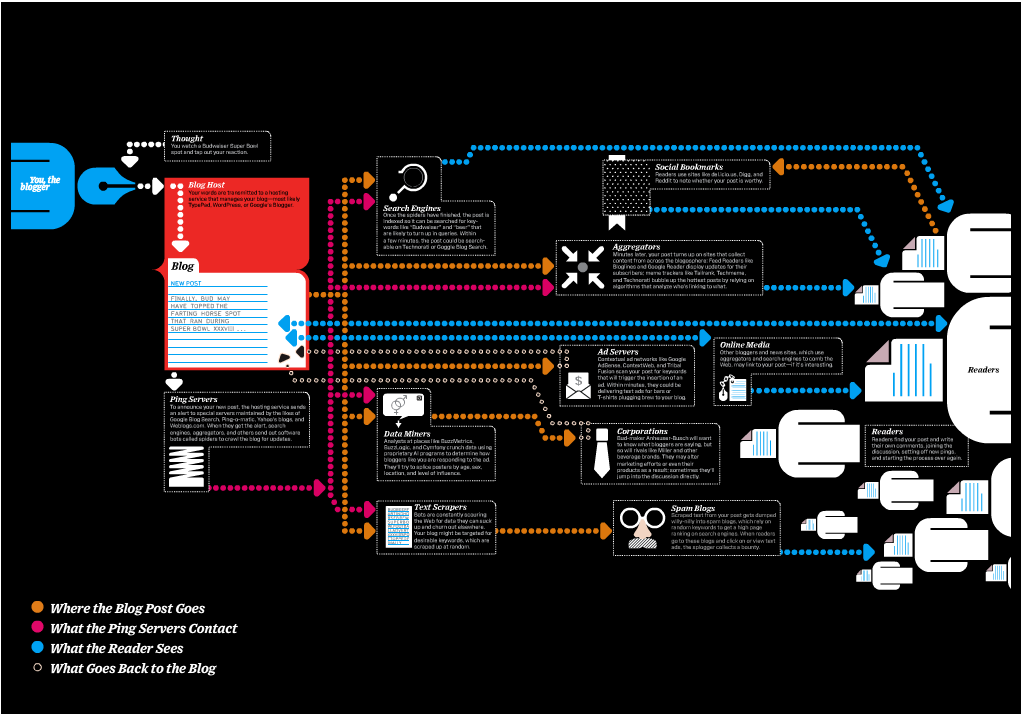
The Life Cycle of a Blog Post, From Servers to Spiders to Suits — to You – Frank Rose: Wired Magazine 22/01/2007

You have a blog. You compose a new post. You click Publish and lean back to admire your work. Imperceptibly and all but instantaneously, your post slips into a vast and recursive network of software agents, where it is crawled, indexed, mined, scraped, republished, and propagated throughout the Web. Within minutes, if you’ve written about a timely and noteworthy topic, a small army of bots will get the word out to anyone remotely interested, from fellow bloggers to corporate marketers. Let’s say it’s Super Bowl Sunday and you’re blogging about beer. You see Budweiser’s blockbuster commercial and have a reaction you’d like to share. Thanks to search engines and aggregators that compile lists of interesting posts, you can reach a lot of people — and Budweiser, its competitors, beer lovers, ad critics, and your ex-boyfriend can listen in. “You just need to know how to type,” says Matthew Hurst, an artificial intelligence researcher who studies this ecosystem at Microsoft Live Labs.

The Life Cycle of a Blog Post, From Servers to Spiders to Suits — to You

Persépolis virtual

Confira persepolis3D.com

Persepolis Reconstruction

The goal of this endeavour is to bring Persepolis back to life – not only to show the complexities of its urban design but also to illuminate the wealth of details to a wide spectrum of both professionals and interested laymen alike. The presented virtual reconstruction is based on the documentation obtained from the excavations led by E. Herzfeld, F. Krefter and E. F. Schmidt. Especially helpful to our project was the tremendous efforts of the architect, Friedrich Krefter, who in 1933 oversaw the excavations of this bygone empire and from 1963 to 1970 established a set of standards for Persepolis and therewith, a wealth of reconstruction drawings and two scale models of the great terraces the Achaemenid residential palace including its volumes, the great entrance vestibules and interiors are all standing once again before our eyes.

Our work has integrated with exactitude all existing and substantiated knowledge of Persepolis. Where personal interpretation was required, we have carefully weighed the suggestions of the archaeologists involved in the aforementioned excavations and have opted for what we believe to be the best solution from the various possibilities.

It is already possible through this virtual reconstruction to step back into the Persian Empire of the sixth century B.C. In the very near future a more advanced phase of this project will be realized. In that phase one will be able to once again visit the great terrace, the monumental buildings, the palatial residences, the public squares and the private gardens from every angle and perspective.

To digitally reconstruct these complex structures in their entirety including the vast richness of detail is an undertaking that will require a great deal of time to accomplish. The specific buildings can only gradually be created and the great terrace will be built step by step. What we at this point in time are presenting to you represents only the preliminary fruits of our labour and will be both qualitatively and quantitatively further developed – the results of which can be monitored through our updates on this website.

PDQ: The Past Discussed Quarterly

Você está acompanhando esta iniciativa? Da criação de uma nova revista trimestral online, the Past Discussed Quarterly, com os melhores posts dos blogs sobre a Antiguidade?

About PDQ

PDQ is a journal designed to provide a bridge between blogging and academia. It will provide stable citeable references for selected weblog posts focussed upon or of interest to the pre-Renaissance past. It is compiled from articles submitted by bloggers on a quarterly basis. The journal is available in three formats. There is a PDF downloadable copy for free. There is a paper copy which can be ordered via Lulu, which is set to the cost of printing and delivery only. Finally we intend that the journal will also be placed in a repository for long-term curation. Until the details are finalised it will be available in XHTML format from a server based at NYU’s Institute for the Study of the Ancient World. PDQ is released under a Creative Commons BY-NC-ND licence, making it freely copyable. We are looking for submissions on any medieval / ancient / prehistoric topics from bloggers which fall into the categories below. Additionally each edition has a theme which we welcome submissions from historians and archaeologists of any period to contribute to. See the Calls for Papers for forthcoming topics. Submission deadlines are the ends of February, May, August, November.

Why PDQ?

If weblogs are producing material that’s getting cited in peer-reviewed literature then why is PDQ necessary? Weblogs are transitory and may disappear at short notice. The same can be said of print publications, it can be difficult to secure a copy of a publication if its gone out of print – especially if the print run was only a couple of hundred copies. Weblogs can also be edited which means that two people citing the same URL might not be citing the same text. PDQ aims to provide a canonical version of the article in a citation-friendly format. It also aims to preserve included entries for a long period of time.

Leia:
A Blog Carnival / Journal Proposal: The Past Discussed Quarterly – Ancient World Bloggers Group: February 8, 2008
PD(Q) from Comments to a Post: What are we blogging for? – Ancient World Bloggers Group: February 12, 2008
Blogging and the PDQ – Ancient World Bloggers Group: February 13, 2008
Is PDQ a good idea? An academic perspective – Ancient World Bloggers Group: February 17, 2008

A arqueologia de Nazaré

Leia sobre as recentes escavações feitas em Nazaré: “What good thing can come out of Nazareth?” em The View from Jerusalem: February 16, 2008.

Last century’s excavations of Nazareth by the Franciscans led to a rather remarkable reconstructed picture of the domiciles and government of this New Testament town. After having uncovered a little more than an acre of rocky surface with little or no evidence for walls, Bagatti and his team probed the numerous holes in the surface to find scores of intact storage caves, cisterns, silos and installations. With nothing more to build upon, the domiciles of this Galilean village appeared to be caves in a rocky hill, which could have housed only a few hundred inhabitants.

Recent excavations and surveys within the immediate surroundings of ancient Nazareth, have uncovered realia left behind by the inhabitants of the original town. These remnants can help us to better understand and define its physical structure and social character.

In an area just 500 meters away from the remains of the ancient town and present Basilica, the staff of the University of the Holy Land surveyed and excavated a farm and stone quarries associated with the town’s construction and the livelihood of its inhabitants.

The quarries, dating to the late Hellenistic and early Roman periods, bear witness to the stone-built buildings which were constructed in the nearby town. The dimensions of the stones match those found in other Galilean towns and cities. The stony slopes were quarried, yielding squared stones to build homes in the town and leveled depressions on the ground to hold the terraces.

Remains from the first centuries BC and AD were found including pottery, watch towers, agricultural terraces and a wine press. Advanced methods of viticulture and agriculture was practiced at the farm as has been revealed by excavations of the early terrace systems. An ancient terraced road was also found cutting though the farm connecting ancient Nazareth with nearby Sepphoris and Jaffia. Coins from this period were also unearthed in other excavations in the vicinity of the town’s spring. Little doubt can now persist that the Nazareth of the Second Temple Period, Jesus and his fellow townspeople, was a bustling Galilean town.

If so, why has the evidence for first century Nazareth been brought into question? First of all, first century pottery and lamps were in fact found by Bagatti during the excavation of the infrastructure of the town, its cisterns, silos and storage caves (with lids still fitted to the openings on the horizontal rock surfaces). In fact, a sizable wall belonging to a public building, dated by him to the first century, was discovered under the Byzantine Church. All of this was published in the original report.

The problem comes when one paints the picture, as has been done, of a town of two hundred and fifty inhabitants who lived in the caves of a rocky hill (bringing into question the feasablity of the synagogue of the Gospel story). Why is the evidences for walled houses and buildings virtually lacking from the earlier excavations if recent excavations have revealed first century quarries which provided cut stones for building the town? The answer lies in the construction of the Byzantine Church. The ruins of Roman period Nazareth were the most available source of stone for building the Byzantine Church. After the stones were robbed out from the ruins, all that was left behind was one of the best preserved set of basement systems found in the Galilee (…).

The official final publication of these excavations has just appeared recently in the Bulletin of the Anglo-Israel Archaeological Society vol. 25 (2007) pp. 19-79: S. Pfann, R. Voss, Y. Rapuano, “Surveys and Excavations at the Nazareth Village Farm (1997–2002): Final Report”. The summary of the ceramic finds from this rather lengthy article has been provided by Antonio Lombatti here.

Resenhas na RBL: 13.02.2008

As seguintes resenhas foram recentemente publicadas pela Review of Biblical Literature:

Brian J. Abasciano
Paul’s Use of the Old Testament in Romans 9.1-9: An Intertextual and Theological Exegesis
Reviewed by Thomas Gillespie

François Bovon
Luc le théologien
Reviewed by Claire Clivaz

Emmanuel Friedheim
Rabbinisme et Paganisme en Palestine romaine: Étude historique des Realia talmudiques (Ier-IVème siècles)
Reviewed by Sabrina Inowlocki

Luke Timothy Johnson
Hebrews: A Commentary
Reviewed by Wolfgang Kraus

Melody Knowles, Esther Menn, John Pawlikowski, and Timothy Sandoval, eds.
Contesting Texts: Jews and Christians in Conversation about the Bible
Reviewed by Ithamar Gruenwald

Amy-Jill Levine, ed., with Maria Mayo Robbins
A Feminist Companion to the New Testament Apocrypha
Reviewed by James Elliott

Edmondo F. Lupieri; Maria Poggi Johnson and Adam Kamesar, trans.
A Commentary on the Apocalypse of John
Reviewed by Tobias Nicklas

George W. E. Nickelsburg
Resurrection, Immortality, and Eternal Life in Intertestamental Judaism and Early Christianity
Reviewed by Tony Costa

Stanley E. Porter, ed.
The Messiah in the Old and New Testaments
Reviewed by Michael F. Bird
Reviewed by James Hamilton Charlesworth

Thomas Römer
The So-Called Deuteronomistic History: A Sociological, Historical and Literary Introduction
Reviewed by Ernst Axel Knauf

Hans-Christoph Schmitt
Arbeitsbuch zum Alten Testament: Grundzüge der Geschichte Israels und der alttestamentlichen Schriften
Reviewed by Christoph Levin

Para saber o que acontece em Roma

Um bom endereço é o blog Settimo Cielo, de Sandro Magister.

Também deve ser considerado o site, do mesmo Sandro Magister, chiesa.

Atualização/Update: 26.03.2009:
Devo observar, um ano após escrever este post, que Sandro Magister caminha e, decididamente, se encaminha para posturas cada vez mais apologéticas, anacrônicas e reacionárias… Infelizmente! Retiro a recomendação presente no título.

Sandro Magister por ele mesmo em Chi Sono:

Ho studiato teologia, filosofia e storia alla Facoltà Teologica di Milano e all’Università Cattolica del Sacro Cuore. Nel 1967 ho conseguito la licenza in teologia. Sono inviato del settimanale “L’espresso”, su cui scrivo dal 1974. Sono specializzato in informazione religiosa, in particolare sulla Chiesa cattolica e il Vaticano [sublinhado meu]. Ho scritto due libri di storia politica della Chiesa italiana: “La politica vaticana e l’Italia 1943-1978”, Roma, 1979, e “Chiesa extraparlamentare. Il trionfo del pulpito nell’età postdemocristiana”, Napoli, 2001. Sul blog “Settimo Cielo” scrivo dal maggio del 2003. Ma prima di esso ho creato il sito www.chiesa, di cui il blog è un corredo per i lettori italiani. Il sito www.chiesa, infatti, è diretto a un pubblico internazionale. Dall’autunno del 2002 è integralmente bilingue, in italiano e in inglese. Dall’autunno del 2006 è anche in francese e spagnolo. Il sito raggiunge una platea vasta e crescente di lettori: circa la metà in Italia, un terzo negli Stati Uniti, gli altri in tutto il mondo, dal Giappone all’Argentina, dal Sudafrica alla Svezia, dall’India alla Cina.

Mel Gibson e sua paixão

Depois de tanto bafafá [veja aqui sinônimos], em 2004, causado pelo filme A Paixão de Cristo, aí está, no noticiário, de novo, Mel Gibson e sua paixão…

Deviam chamar Pilatos para julgar o caso.


Roteirista de “A Paixão de Cristo” processa Mel Gibson por má-fé

Um dos roteiristas de “A Paixão de Cristo”, dirigido por Mel Gibson, decidiu processar o ator e diretor por não ter recebido uma “justa compensação” por seu trabalho na produção.

Benedict Fitzgerald, que escreveu o roteiro do filme junto com Gibson, está pedindo US$ 5 milhões ( R$ 8,8 milhões) na ação que abriu nesta segunda-feira na Suprema Corte de Los Angeles, informa o site da revista “People”.

Fitzgerald acusa Gibson de fraude, descumprimento de contrato e práticas de negócio injustas.

“Ben foi uma vítima (…) de Gibson, que se aproveitou da paixão desenfreada pelo projeto e das crenças pessoais e espirituais do roteirista”, diz o processo.

Fitzgerald alega que, além de “enganado”, foi vítima de “táticas conspiratórias” forjadas por Gibson, que havia lhe assegurado que o filme seria um projeto pequeno, de entre US$ 4 milhões (cerca de R$ 7 milhões) e US$ 7 milhões (cerca de R$ 12,3 milhões), e não daria lucro.

No entanto, “A Paixão de Cristo” se tornou um dos maiores sucessos de bilheteria de 2004, com mais de US$ 600 milhões (cerca de R$ 1 bilhão) arrecadados ao redor do mundo.

Fitzgerald diz que cobrou US$ 75 mil (R$ 132 mil) por seu trabalho e que teve que pedir a Gibson outros US$ 200 mil (R$ 352 mil) emprestados para pagar despesas.

Fonte: Folha Online – 12/02/2008

Dead Sea Discoveries

Dead Sea Discoveries. A Journal of Current Research on the Scrolls and Related Literature

Editors: Eibert J.C. Tigchelaar (Florida State University), Hindy Najman (University of Toronto), Sarianna Metso (University of Toronto)

Editorial Board: M.J. Bernstein, G.J. Brooke, E. Chazon, J.J. Collins, D. Dimant, H. Eshel, C.A. Evans, F. García Martínez, M. Kister, A. van der Kooij, A. Lange, J. Magness, J.P. Meier, G.W.E. Nickelsburg, B. Nitzan, E. Puech, L.H. Schiffman, E. Schuller, M.E. Stone, E. Tov, E. Ulrich, J.C. VanderKam

Dead Sea Discoveries is an international journal dedicated to the study of the Dead Sea Scrolls and associated literature. The journal is primarily devoted to the discussion of the significance of the finds in the Judean Desert for Biblical Studies, and the study of early Jewish and Christian history. Dead Sea Discoveries has established itself as an invaluable resource for the subject both in the private collections of professors and scholars as well as in the major research libraries of the world.

Mais três livros do Seminário Europeu de Metodologia Histórica

As três publicações são o resultado do Seminário Europeu de Metodologia Histórica.

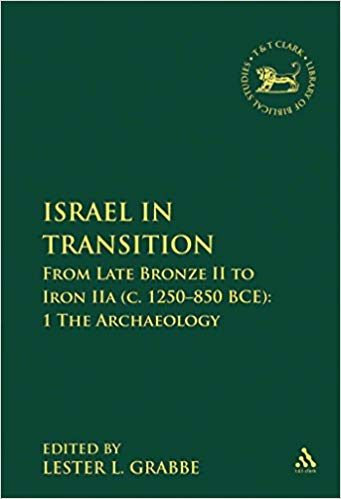
GRABBE, L. L. (ed.) Israel in Transition: From Late Bronze II to Iron IIA (c. 1250-850 BCE): 1 The Archaeology. London: T & T Clark, 2008, 224 p. – ISBN 9780567027269.

GRABBE, L. L. (ed.) Israel in Transition: From Late Bronze II to Iron IIA (c. 1250-850 BCE): 1 The Archaeology. London: T & T Clark, 2008For more than a decade the European Seminar in Historical Methodology has debated the history of ancient Israel (or Palestine or the Southern Levant, as some prefer). A number of different topics have been the focus of discussion and published collections, but several have centered on historical periods. The really seminal period–one of great debates over a number of different topics–is the four centuries between the Late Bronze II and Iron IIA, but it seemed appropriate to leave it toward the end of the various historical periods. It was also important to give a prominent place to archaeology, and the best way to do this seemed to be to have a special Seminar session devoted entirely to archaeology


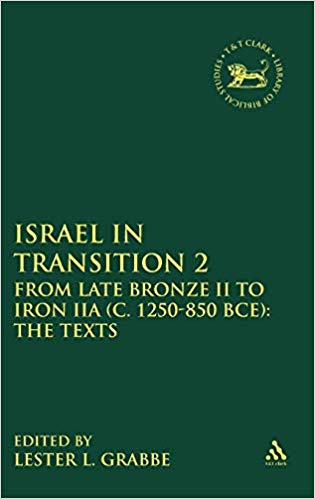
GRABBE, L. L. (ed.) Israel in Transition: From Late Bronze II to Iron IIA (c. 1250-850 BCE): 2 The Texts. London: T & T Clark, 2011, 260 p. – ISBN 9780567649485.

Israel in Transition 2 is the second in a two-volume work addressing some of the historical problems relating to the early history of Israel, from its first mention around 1200 BCE to the beginnings of the kingdoms of Israel and Judah. During this four century transition period Israel moved from a group of small settlements in the Judean and Samarian hill country to the two kingdoms of Israel and Judah, occupying much of the land on the west side of the Jordan.

The present volume engages with the relevant texts. These include various inscriptions, such as the Tel Dan inscription and the Assyrian inscriptions, but also an GRABBE, L. L. (ed.) Israel in Transition: From Late Bronze II to Iron IIA (c. 1250-850 BCE): 2 The Texts. London: T & T Clark, 2011examination of the biblical text. The articles discuss various individual problems relating to Israelite history, but ultimately the aim is to comment on historical methodology.

The debate among Seminar members illustrates not only the problems but also suggests solutions and usable methods. The editor provides a perspective on the debate in a Conclusion that summarizes the contributions of the two volumes together.


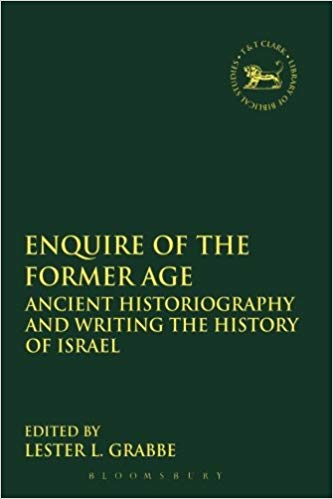
GRABBE, L. L. (ed.) Enquire of the Former Age: Ancient Historiography and Writing the History of Israel. London: T & T Clark, 2013, 304 p. – ISBN 9780567575302.

GRABBE, L. L. (ed.) Enquire of the Former Age: Ancient Historiography and Writing the History of Israel. London: T & T Clark, 2013When methodology relating to the history of ancient Israel is discussed, the issue of historiography is frequently injected into the debate. This includes both principles of writing history from a modern perspective and also historiography as it relates to ancient writings. The first part of this most recent volume in the European Seminar in Historical Methodology series contains essays on historiography, including such well-known scholars as Ehud Ben Zvi, Philip Davies, and Axel Knauf. The second part is made up of reviews of histories of Israel or related works by such writers as William Dever, Baruch Halpern, Steven McKenzie, Mario Liverani, Alberto Soggin, Lester Grabbe, Jens Bruun Kofoed, and Iain Provan, V. Phillips Long, and Tremper Longman, III. Reviewers include Rainer Albertz, Niels Peter Lemche, Joseph Blenkinsopp, Philip Davies, Bob Becking, Ehud Ben Zvi, and Lester Grabbe. The original authors had the opportunity to respond to the reviews, while the editor provides an introduction that summarizes the various contributions and a conclusion that provides personal reflections on the debate.