Biblioblogueiro de fevereiro de 2007: Jim West

Brandon Wason, em Biblioblogs.com, entrevista Jim West, autor do biblioblog Dr Jim West, escolhido como o biblioblogueiro do mês de fevereiro de 2007.

Jim West é por demais conhecido para ser apresentado. Só lembro aos leitores que, como diz Brandon Wason, ele é the most prolific blogger in the history of the medium, ou, como eu disse certa vez em um post, o mais animado dos biblioblogueiros.

Chamou minha atenção, de modo especial, um trecho da entrevista, onde Jim fala sobre o que é determinante para a qualidade de um blog, ou melhor, um biblioblog:

If a blog integrates somehow academic biblical / theological studies with current events, then you really are on to something. Or, as Karl Barth put it, you should have a “Bible in one hand and the newspaper in the other”. And having such, integrate them in such a way that the wider public realizes that the Biblical message is meaningful to them, today.

Ou seja: aquilo que sempre defendemos em terras tupiniquins: Bíblia e Realidade. Ou: estimulado pelos problemas da realidade (pré-texto), busca-se uma luz na Bíblia (texto), que é lida e aprofundada dentro da comunidade (con-texto), como explicou tão bem Carlos Mesters no seu livro Flor sem defesa.

E, claro, fiquei feliz ao ver o Observatório Bíblico citado entre os biblioblogs preferidos do Jim.

Ao lado de Chris Tilling (Chrisendom – Tübingen, Alemanha), Chris Heard (Higgaion – Malibu, California, USA), Mark Goodacre (NT Gateway Weblog – Durham, North Carolina, USA), Brandon Wason (Novum Testamentum Blog – Atlanta, Georgia, USA) , Ben Myers (Faith and Theology – Brisbane, Austrália), James Spinti (Idle Musings of a Bookseller – Winona Lake, Indiana, USA) e James Crossley (Earliest Christian History – Sheffield, Reino Unido).

Chamado de Paris

Folha Online: 03/02/2007 – 10h09

da Efe, em Paris

Mais de 40 países pedem organização da ONU para o meio ambiente

Mais de 40 países apóiam a criação de uma organização da ONU para o Meio Ambiente proposta na conferência internacional “Cidadãos da Terra”, que terminou nesta sábado em Paris com um chamado ao combate contra a degradação do planeta. “Hoje, sabemos que a humanidade está destruindo, a uma velocidade aterrorizadora, os recursos e equilíbrios que permitiram seu desenvolvimento e que determinam seu futuro“, diz o “Chamado de Paris”, lido no fim da conferência pelo anfitrião do encontro, o presidente da França, Jacques Chirac (cont.)

Leia Mais:
Especial Mudanças Climáticas
Humans blamed for climate change

Fundamentalismo: um modo de estar no mundo

Vira e mexe, passa boi passa boiada, demora… mas, como não há nada como um dia depois do outro, o que escrevo na Ayrton’s Biblical Page e no Observatório Bíblico, acaba, de vez em quando – embora não seja sempre, nem frequente, muito menos dominante, ainda bem! – provocando reações fundamentalistas de determinados leitores indignados com a leitura acadêmica ou “científica” da Bíblia.

Certos fundamentalistas atiram para todo lado: na exegese moderna de modo geral; nos exegetas como um grupo de intelectuais que “matam” a Bíblia e que deveriam, portanto, ser silenciados, podados, extintos, em benefício da “verdadeira” Palavra de Deus; nos exegetas que chegam a ser – anacronicamente – comparados aos “doutores da Lei” do NT e responsabilizados, como aqueles (gente, acorda: foram os romanos!), pela morte de Jesus; nos exegetas “críticos” e destruidores da verdade; na ciência moderna como compreensão inadequada e até mesmo descabida da realidade; na razão humana como negação da fé… Reações que sempre procuram afirmar sua legitimidade com citações da Bíblia, com leituras literalistas dos textos bíblicos (uma tradução perrengue pode algum dia ser considerada texto literal?)… e por aí afora.

Acabo de chegar de mais uma reunião do grupo dos Biblistas Mineiros, ocorrida ontem em Belo Horizonte, reunião de dia inteiro, muito proveitosa, onde, entre outras coisas, discutimos o tema de nosso próximo número da revista Estudos Bíblicos publicada pela Vozes. Que tratará da questão dos métodos de leitura da Bíblia. E de sua necessidade. E, é claro, em nosso estudo, mesmo que captada apenas com o canto do olho, aparecerá a análise do modo fundamentalista de ver a realidade. Modo que recusa como necessária qualquer metodologia exegética porque acredita ter acesso direto e exclusivo ao significado do texto bíblico.

Se esse pessoal lesse Kant e soubesse da distinção entre “noumenon” e “fenômeno”. Se esse pessoal lesse física quântica e descobrisse o quanto a realidade é diferente do que aparenta ser. Ah, mas não lê. E nem relê! Já dizia o grande R. Barthes: Quem não relê um texto, lê, em todos os textos, sempre o mesmo texto.

Quer exemplos? Leia nos comentários dos posts do Observatório Bíblico aqui e aqui.

Recomendo a releitura – quem não relê, já sabe, não? – do post que escrevi em 7 de janeiro de 2006: Fundamentalismo: um desafio ecumênico.

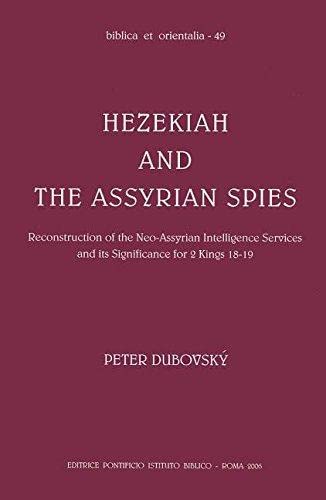
Ezequias e os espiões da Assíria

DUBOVSKÝ, P. Hezekiah and the Assyrian Spies: Reconstruction of the Neo-Assyrian Intelligence Services and its Significance for 2 Kings 18–19. Roma: Pontificio Istituto Biblico, 2006, xviii + 308 p. ISBN 9788876533525.

Resenha de Alan Lenzi – Journal of Near Eastern Studies. Chicago, vol. 71, n. 1, p. 121-123, 2012.DUBOVSKÝ, P. Hezekiah and the Assyrian Spies: Reconstruction of the Neo-Assyrian Intelligence Services and its Significance for 2 Kings 18–19. Roma: Pontificio Istituto Biblico, 2006

Neste estudo bem fundamentado, Peter Dubovský fornece uma nova leitura intrigante de 2 Reis 18-19, o relato da invasão de Judá por Senaquerib em 701 AEC, à luz dos serviços de inteligência neoassírios. Embora Dubovský caracterize seu trabalho como uma contribuição para os estudos bíblicos, a maior parte do livro (p. 32-238) reconstrói a estrutura e as operações da rede de inteligência neoassíria e, portanto, também atrairá os assiriólogos.

Dubovský divide seu livro em seis capítulos. A introdução, capítulo 1 (p. 1-9), fornece uma breve visão geral de estudos anteriores, uma declaração de propósito e breves notas sobre fontes e definições. O propósito declarado do autor é “contextualizar as fontes bíblicas [de 2 Reis 18-19] no sentido de investigar até que ponto elas refletem a realidade dos serviços de inteligência neoassírios” (p. 5). Informado por uma ampla gama de literatura de inteligência teórica (incluindo trabalhos em russo e tcheco), Dubovský define “inteligência” de três maneiras: informação, atividade (ou seja, coleta e análise) e organização (a rede). Ele é rápido em notar, no entanto, que os agentes não são meramente coletores e analisadores; eles também implementam várias operações, especialmente “engano, contrainteligência, guerra psicológica e ação secreta” (p. 8).

No capítulo 2 (p. 10-31), Dubovský analisa a narrativa bíblica para extrair suas percepções da guerra psicológica neoassíria e os tipos de inteligência que os assírios precisariam para conduzir tais operações com eficácia. O objetivo é entender como a Bíblia apresenta os assírios do ponto de vista das atividades de inteligência. Uma pequena falha em uma leitura interessante é o breve uso de 2 Crônicas 29-32 (p. 29) para preencher a apresentação do Deuteronomista da inteligência política assíria.

Dubovský reconstrói a rede de inteligência imperial neoassíria e as práticas associadas nos próximos dois capítulos.

No capítulo 3 (p. 32-160), trabalhando a partir de estudos de caso organizados por área geográfica (Urartu, Elam, Babilônia e deserto da Arábia, além de uma seção sobre espionagem atrás das linhas inimigas), Dubovský oferece uma série de situações que ilustram a diversidade e abrangência dos interesses de inteligência neoassírios e os vários meios pelos quais eles obtiveram informações. Geralmente, os serviços de inteligência operavam nas províncias, zonas de amortecimento e ao longo das fronteiras, mas também tentavam aprender assuntos dentro das potências imperiais concorrentes. As prioridades de inteligência incluíam: monitorar o inimigo (que abrangia, por exemplo, o movimento de tropas, deserções, conflitos fronteiriços, atividades militares de outros reinos e o paradeiro e até a saúde de reis estrangeiros); informar sobre interesses econômicos (que abrangem questões como contrabando, mercados negros, rotas comerciais, transporte de madeira e encontrar e manter contatos apropriados para auxiliar nas operações de campo); e observando uma variedade de tópicos tão diversos como agricultura, topografia, etnografia (por exemplo, catalogação de tribos árabes) e atos religiosos (por exemplo, importantes encenações rituais).

O Capítulo 4 (p. 161-188) oferece dois estudos de caso, baseados em cartas e anais, que examinam a implementação assíria de táticas de guerra psicológica durante as campanhas conduzidas por Tiglat-Pileser III e Sargão II. Dubovský apresentou aqui uma sólida reconstrução dos serviços de inteligência neoassírios. Em muitos dos casos, ele detalha os meios de coleta de informações (interceptação de cartas, captura de um espião ou suborno de um funcionário local) e ilustra o fluxo de informações pela rede, do campo para cima. Ele também demonstra como os assírios construíram mecanismos de redundância em seu sistema para garantir a precisão das informações e a fidelidade dos agentes. A maioria das evidências de apoio de Dubovský é reconstruída a partir de textos epistolares em vários estados de preservação dos arquivos neoassírios. Suas reconstruções são razoáveis ​​e sustentadas por uma argumentação completa, mas ele também frequentemente (e compreensivelmente) admite que a evidência permite outras interpretações. Desentendimentos sobre alguns detalhes são inevitáveis.

À luz de suas descobertas, Dubovský retorna à Palestina e ao material bíblico no capítulo 5 (p. 189-260). Depois de avaliar evidências textuais e arqueológicas para demonstrar a presença de agentes de inteligência neoassírios na área, Dubovský avalia a precisão histórica das percepções bíblicas da inteligência assíria e oferece uma leitura crítica da narrativa bíblica. Ele conclui que a narrativa bíblica apresenta um retrato preciso da inteligência neoassíria, embora isso não garanta automaticamente, ele tem o cuidado de notar, a historicidade da narrativa ou sua composição durante o período neoassírio. Em sua leitura da redação final, Dubovský afirma que os editores bíblicos estavam familiarizados com os estratagemas do serviço de inteligência assírio, especialmente suas alegações de onisciência, e o contrapuseram de três maneiras: praticamente, exaltando as habilidades de liderança de Ezequias; literariamente, minando a precisão das afirmações assírias (e, portanto, sua suposta onisciência) por meio de redação textual criativa; e teologicamente, retratando os assírios como blasfemadores e Iahweh como aquele que realmente entendia e controlava a situação. Um breve resumo das descobertas do autor (capítulo 6; p. 261-263) e vários gráficos no apêndice encerram o volume.

Alan LenziNo geral, Dubovský ofereceu uma nova perspectiva sobre 2 Reis 18–19, além de oferecer uma importante reconstrução histórica para os interessados no império neoassírio. O livro é altamente recomendado. Mas tenho algumas dúvidas. Primeiro, o livro deveria ter incluído uma série de mapas para ajudar o leitor a seguir os detalhes geográficos dos estudos de caso nos capítulos 3 e 4. Segundo, o livro inclui apenas um índice de autores modernos, mas seria significativamente mais fácil de usar se incluísse um índice de assuntos, bem como um índice de textos antigos. Finalmente, embora haja uma série de pequenos erros de digitação ao longo do texto, uma parte significativa do texto (com notas de rodapé também) é repetida nas páginas 14-15, e os títulos das tabelas 24 e 25 (p. 220) devem ser trocados. Essas questões menores, no entanto, em nada prejudicam a substância do belo trabalho de Peter Dubovský.

Peter Dubovský é professor de exegese do Antigo Testamento no Pontifício Instituto Bíblico, Roma.

Alan Lenzi é professor no Departamento de Estudos Religiosos da Universidade do Pacífico, Stockton, Califórnia, USA.


In this well-argued study, Peter Dubovský provides an intriguing new reading of 2 Kings 18–19, the account of Sennacherib’s invasion of Judah in 701 b . c . e ., in light of Neo-Assyrian intelligence services. Although Dubovský characterizes his work as a contribution to biblical scholarship, the lion’s share of the book (pp. 32–238) reconstructs the structure and operations of the Neo-Assyrian intelligence network, and will thus also appeal to Assyriologists.

Dubovský divides his book into six chapters. The introduction, chapter 1 (pp. 1–9), provides a brief overview of previous scholarship, a statement of purpose, and brief notes on sources and definitions. The author’s stated purpose is “to contextualize the biblical sources [of 2 Kings 18–19] in the sense of investigating to what degree they reflect the reality of Neo-Assyrian intelligence services” (p. 5). Informed by a wide range of theoretical intelligence literature (including works in Russian and Czech), Dubovský defines “intelligence” in a threefold manner: information, activity (that is, collection and analysis), and organization (the network). He is quick to note, however, that agents are not merely collectors and analyzers; they also implement various operations, especially “deception, counterintelligence, psychological warfare, and covert action” (p. 8).

In chapter 2 (pp. 10–31), Dubovský analyzes the biblical narrative to draw out its perceptions of Neo-Assyrian psychological warfare and the kinds of intelligence the Assyrians would have needed to conduct such operations effectively. The goal is to understand how the Bible presents the Assyrians from the point of view of intelligence activities. One minor flaw in an otherwise interesting read is the brief use of 2 Chronicles 29–32 (p. 29) to fill out the Deuteronomist’s presentation of Assyrian political intelligence.

Dubovský reconstructs the Neo-Assyrian imperial intelligence network and associated practices in the next two chapters. In chapter 3 (pp. 32–160), working from case studies organized by geographical area (Urartu, Elam, Babylonia, and the Arabian Desert, plus a section on espionage behind enemy lines), Dubovský offers a host of situations that illustrate the diversity and comprehensiveness of Neo-Assyrian intelligence interests and the various means by which they obtained information. Generally, the intelligence services operated in the provinces, buffer zones, and along borders, but would also attempt to learn matters inside competing imperial powers. Intelligence priorities included: monitoring the enemy (which embraced, for example, the movement of troops, desertions, border conflicts, military activities of other kingdoms, and the whereabouts and even health of foreign kings); reporting on economic interests (which encompassed issues such as smuggling, black markets, trade routes, timber transport, and finding and maintaining appropriate contacts to assist in field operations); and noting a variety of topics as diverse as agriculture, topography, ethnography (for example, cataloging Arabian tribes), and religious acts (for example, important ritual enactments).

Chapter 4 (pp. 161–88) offers two extended case studies, based on letters and annals, that examine Assyrian implementation of psychological warfare tactics during campaigns conducted by Tiglath-pileser III and Sargon II. Dubovský has presented here a solid reconstruction of Neo-Assyrian intelligence services. In many of the cases, he details the means of collecting intelligence (interception of letters, capture of a spy, or bribing a local official) and illustrates the flow of information through the network, from the field on up. He also demonstrates how the Assyrians built redundancy mechanisms into their system to ensure accuracy of information and the fidelity of agents. Most of Dubovský’s supporting evidence is reconstructed from epistolary texts in various states of preservation from the Neo-Assyrian archives. His reconstructions are reasonable and supported by thorough argumentation, but he also frequently (and understandably) admits that the evidence permits other interpretations. Disagreements over some details are inevitable.

In the light of his findings, Dubovský returns to Palestine and the biblical material in chapter 5 (pp. 189–260). After assessing textual and archaeological evidence toPeter Dubovský demonstrate the presence of Neo-Assyrian intelligence agents in the area, Dubovský assesses the historical accuracy of the biblical perceptions of Assyrian intelligence and offers a redaction-critical reading of the biblical narrative. He concludes that the biblical narrative presents an accurate picture of Neo-Assyrian intelligence, though this does not automatically affirm, he is careful to note, the historicity of the narrative or its composition during the Neo-Assyrian period. In his reading of the final redaction, Dubovský contends that the biblical editors were savvy to the ploys of the Assyrian intelligence service, especially its claims of omniscience, and they countered it in three ways: practically, by exalting Hezekiah’s leadership skills; literarily, by undermining the accuracy of Assyrian assertions (and thus their supposed omniscience) through creative textual redaction; and theologically, by depicting the Assyrians as blasphemers and Yahweh as the one who truly understood and controlled the situation. A brief summary of the author’s findings (chap. 6; pp. 261–63) and several charts in the appendix conclude the volume.

Overall, Dubovský has offered a fresh perspective on 2 Kings 18–19 while also offering an important historical reconstruction for those interested in the Neo-Assyrian empire. The book is highly recommended. But I have a few quibbles. First, the book should have included a series of maps to help the reader follow the geographical details of the case studies in chapters 3 and 4. Second, the book only includes a modern author index but would be significantly easier to use if it had included a subject index, as well as an ancient text index. Finally, although there are a number of small typos throughout the text, a significant portion of text (with footnotes as well) is repeated on pages 14–15, and the headings of tables 24 and 25 (p. 220) should be exchanged. These minor issues, however, in no way detract from the substance of Peter Dubovský’s fine work.

Tyler Williams estuda Cosmogonias Mesopotâmicas

Tyler Williams, em Codex, vai apresentar e discutir as cosmogonias mesopotâmicas. Isto é particularmente importante para a compreensão de Gn 1-2. Em quatro partes, começando com o post Ideas of Origins and Creation in Ancient Mesopotamia, Part 1, já publicado, serão discutidas as questões metodológicas e os recursos disponíveis para o estudo dos textos mesopotâmicos (parte 1), os textos babilônicos antigos (parte 2), os textos neobabilônicos (parte 3) e, finalmente, na quarta parte, uma síntese das ideias mais importantes que surgiram ao longo do estudo e sua relação com nossa compreensão dos textos bíblicos sobre a criação.

Ele diz:

Next to a close reading of the biblical text, one of the most important steps in its interpretation is knowledge of the ancient cultural and literary context of the Bible (…) Thus, when approaching the biblical creation accounts in Genesis 1 and 2, it is essential to have some knowledge of other ancient Near Eastern creation accounts (…) This is the first of four posts on ideas of creation in ancient Mesopotamia. This post will discuss some methodological issues surrounding the study of Mesopotamian texts and highlight some of the resources available for studying this literature. The second and third posts will survey Old Babylonian texts and Neo-Babylonian texts, respectively. The fourth post will synthesize some of the findings and relate them to our understanding of the biblical creation texts.

Isto até me anima a terminar um trabalho iniciado tempos atrás, de organização e publicação dos textos de um seminário no qual trabalhei com 15 alunos do CEARP sobre Cosmogonias Antigas e Cosmologias Modernas. Estudamos – em nível de introdução, pois isto ocorreu na graduação em Teologia – as Cosmogonias mesopotâmicas, egípcias, cananeias e israelitas (bíblicas), finalizando com um apanhado geral das várias cosmologias científicas modernas.

A compreensão das cosmogonias do Antigo Oriente Médio em seus contextos trouxe uma notável contribuição para a compreensão dos textos bíblicos de criação. Não estávamos em busca de semelhanças ou paralelos entre os textos orientais antigos, os textos bíblicos e as diferentes teorias da cosmologia moderna. Buscamos entendê-los dentro dos limites de sua época e função. Valeu a pena.

A dificuldade que enfrentei na época e que permanece para a publicação – isto explica o seu adiamento – diz respeito aos próprios textos. A maioria está em inglês e alguns em espanhol. Estas são traduções dos originais, feitas por especialistas da área e bastante confiáveis. Os poucos textos que tenho em português, porém, são tradução de tradução, pois vieram do inglês ou do francês, o que diminui a sua confiabilidade. Mas, aguardem.

Uma brilhante defesa de Finkelstein

“Finkelstein está usando a arqueologia para interpretar os textos bíblicos e não os textos bíblicos para interpretar a arqueologia. Eu penso que este é o modo correto para se fazer pesquisa arqueológica em regiões e épocas onde há documentação histórica disponível…”

Quem está dizendo isto não sou eu, mas o arqueólogo Christopher O’Brien em seu blog Northstate Science, no post Apologetics Archaeology? onde ele aborda, entre outras coisas, a discutida questão da baixa cronologia proposta por Israel Finkelstein.


Quem é Christopher O’Brien ?
Adjunct Professor of Anthropology at California State University, Chico and Adjunct Faculty at Lassen Community College, Susanville. His day job is as the Forest Archaeologist for Lassen National Forest in northern California. He received his BS in Anthropology from the University of California-Davis and a MA and PhD in Anthropology from the University of Wisconsin-Madison. He is currently working on the zooarchaeology of several cave and rockshelter sites in northern California, and the historical ecology of several species. He has also been directing archaeological excavations in western Tanzania since 2002.

Consciente de minha incompetência no assunto – quando obtenho uma resposta, ela só me serve para fazer outras maiores perguntas! – limito-me a transcrever alguns trechos do post de Christopher O’Brien. Claro que recomento a leitura de todo o texto. E do livro de Finkelstein & Silberman, The Bible Unearthed, ou, pelo menos, de sua resenha.


O que é a Baixa Cronologia?

Briefly, for readers unfamiliar with the “Low Chronology” debate, archaeologist Israel Finkelstein has suggested, among other things, that strata at many archaeological sites in the Middle East originally dated to the 10th century BCE should be “lowered” to the 9th century BCE. This may seem an innocuous adjustment in dates, but in fact it wreaks absolute havoc with the idea that the bible has any but the most minimal historical validity. It pretty much removes the epoch of David and Solomon from historical consideration, at least as it is represented in the biblical texts. As such it is one of the issues at the heart of the minimalist/maximalist debate in bibical…ah, excuse me, Syro-Palestinian archaeology.

O que faz Finkelstein?

I was struck more with Finkelstein’s focus on explaining the archaeology of the region in the context of issues more familiar to me as a research archaeologist: population increase, adaptation, migration and population displacement, environmental context, etc. Finkelstein is an archaeologist whom I expect would feel comfortable in the realm of hunter-gatherer archaeology. I think he ultimately gets what archaeology is all about: understanding past human behavior. More to the point, I think he does what a good archaeologist should: he puts the archaeology ahead of the history as the primary source of explanatory power. And I get the feeling that his critics are ultimately more concerned with the methodological and theoretical approach he uses, than with the archaeological validation of the Low Chronology, per se.

O que Finkelstein faz que é diferente de seus críticos no debate minimalista/maximalista?

What Finkelstein does differently from his critics, is to approach archaeological interpretation of the region on basis of, well…the archaeology. His hypothesis testing is based upon questions of understanding past human behavior in the context of the material culture left behind by extinct human populations, without the theoretical crutch of assuming historic texts have already captured those behaviors and events. Textual evidence is at best a secondary source of information, another interpretive tool in the archaeologist’s box, if you will. It may come in handy some time down the road…after the chronology has been worked out…after the subsistence and settlement patterns have been worked out…after some questions of culture change have been addressed. Now in actual practice we archaeologists tend to run all those together…no one is going to wait for the perfect chronology before developing explanations of culture change; what I am referring to is how you approach the archaeological record from the very beginning.

Mas e o uso seletivo que Finkelstein faz de textos bíblicos para sustentar suas hipóteses e que é visto como um problema por seus críticos?

I have always been curious about the criticism leveled at Finkelstein that he “selectively” uses biblical text to support his contentions. But this is exactly the level of interpretive power expected by historical texts – the written record of the human past is plagued with error, perspective, limited vantage, experience (or lack thereof), political and economic motivation, and outright deception. The range of interpretive “help” provided by historical texts will range from absolutely zero to some textual fragments that may be very useful; with a whole lot of text of dubious quality either way. I would expect only “selected” text to be of any value in interpreting the archaeological record. In fact, I would argue that the archaeological record provides greater benefit at the interpretation of historical text than the other way around. This is ultimately the crux of biblical minimalism: Finkelstein is using the archaeology to interpret biblical texts; not the biblical texts to interpret the archaeology. I think this is the appropriate way to approach archaeological research in regions and time periods where historical documentation is also available. If my understanding of the minimalist/maximalist debate is even remotely correct in this regard, I must obviously count myself among the minimalists.

Por que os críticos de Finkelstein devem ser olhados com desconfiança?

I am nonetheless suspicious of Finkelstein’s critics, largely because most of them seem to give biblical texts far greater interpretive weight than is justified, at least relative to the actual archaeology. This is not to say that I think all of them are raving biblical literalists, chomping at the bit to use archaeology to “prove the bible”. Some simply see greater interpretive value in historical texts (be they biblical or any other) and reflect this perspective in their archaeological work. I’ve got no issue with this (other than it is not a methodological approach I would favor – I think it puts the “interpretive” cart before the “data” horse) – for those conducting responsible archaeology, it is simply another approach that ultimately can be tested with additional archaeological data. However, I have a growing concern with the ethical framework in which some Syro-Palestinian archaeological projects are being conducted, and this has to do with many of Finkelstein’s critics for whom biblical texts are not simply invoked as a valid interpretive tool, but are viewed a priori as historically accurate. I think this is a serious integrity issue for the future of archaeological research in the region.

Além disso, ele faz duras críticas ao Dr. Joseph Cathey – chega a duvidar de sua qualificação como arqueólogo – e a Steve Ortiz que está escavando Gezer e que chegou, segundo ele, a escrever: “God has called me to do archaeology”, e “the solution to doubts about the bible’s authenticity is to do your own archaeological work”. Diz, de modo direto, Christopher O’Brien:

The Gezer excavations are being led by someone whose sole purpose at doing archaeological work is to “affirm bible history”, leading me to have serious reservations about the integrity of the archaeological work being conducted there. I am particularly distressed in hearing discussions of Ortiz’s work under the title of “Archaeology As Apologetics”. This is a completely asinine description of the real goals of archaeological research – and it completely devastates any authority archaeology may have to tell us about the past. How much evidence at Gezer that doesn’t confirm Ortiz’s preconceived notions of biblical history will see the light of day?

Entretanto, seria bom lembrar aqui que a classificação de minimalista, atribuída a Finkelstein, não é de todo correta. Ele mesmo já recusou, mais de uma vez, esta classificação. Assim como alguns dos chamados “minimalistas”, como Philip Davies e Thomas Thompson, se me recordo bem, não concordam – pelo menos parcialmente – com Israel Finkelstein. As questões relativas à baixa cronologia também não estavam na agenda dos minimalistas. O que ocorre é que algumas conclusões coincidem, mas os estudiosos de Sheffield e Copenhague chegaram a elas por caminhos diferentes e independentes daqueles de Finkelstein. A confusão nasce da classificação de Finkelstein como minimalista por seus críticos. O que eles, os críticos, odeiam mesmo é que os resultados conseguidos pela arqueologia de Finkelstein fortaleceram algumas das posturas dos minimalistas!


Leia o post de Christopher O’Brien na íntegra.

Apologetics Archaeology?

Posted by Christopher O’Brien – Saturday, January 27, 2007

I have been reading with intense interest the discussions on Finkelstein’s Low Chronology taking place at Jim West’s blog, Stephen Cook’s blog, and at Abnormal Interests. Jim West has also reviewed the Bible Unearthed DVD, based on Finkelstein and Silberman’s book of the same name. Briefly, for readers unfamiliar with the “Low Chronology” debate, archaeologist Israel Finkelstein has suggested, among other things, that strata at many archaeological sites in the Middle East originally dated to the 10th century BCE should be “lowered” to the 9th century BCE. This may seem an innocuous adjustment in dates, but in fact it wreaks absolute havoc with the idea that the bible has any but the most minimal historical validity. It pretty much removes the epoch of David and Solomon from historical consideration, at least as it is represented in the biblical texts. As such it is one of the issues at the heart of the minimalist/maximalist debate in bibical…ah, excuse me, Syro-Palestinian archaeology.

I have read Finkelstein’s book and found his reconstruction of the traditional biblical chronology rather interesting. There is clear disagreement on the archaeological validity of the “Low Chronology” and I don’t claim to have sufficient knowledge to comment, although I find myself reading more on the subject. However, I was struck more with Finkelstein’s focus on explaining the archaeology of the region in the context of issues more familiar to me as a research archaeologist: population increase, adaptation, migration and population displacement, environmental context, etc. Finkelstein is an archaeologist whom I expect would feel comfortable in the realm of hunter-gatherer archaeology. I think he ultimately gets what archaeology is all about: understanding past human behavior. More to the point, I think he does what a good archaeologist should: he puts the archaeology ahead of the history as the primary source of explanatory power. And I get the feeling that his critics are ultimately more concerned with the methodological and theoretical approach he uses, than with the archaeological validation of the Low Chronology, per se.

In this respect, I believe I am coming to a different appreciation of the “maximalist/minimalist” debate in Syro-Palestinian archaeology. Probably naively, I had considered this issue solely within the context of interpreting the archaeology in terms of the bible. If you interpret the archaeology in parsimony with the bible, you’re a maximalist; if you interpret the archaeology at variance with the bible, you’re a minimalist. But in either case, my assumption had been that the archaeology was the same and it is only the differential interpretive weight placed upon one or more archaeological components that leads to the split between minimalist and maximalist. Now I’m not so sure. What Finkelstein does differently from his critics, is to approach archaeological interpretation of the region on basis of, well…the archaeology. His hypothesis testing is based upon questions of understanding past human behavior in the context of the material culture left behind by extinct human populations, without the theoretical crutch of assuming historic texts have already captured those behaviors and events. Textual evidence is at best a secondary source of information, another interpretive tool in the archaeologist’s box, if you will. It may come in handy some time down the road…after the chronology has been worked out…after the subsistence and settlement patterns have been worked out…after some questions of culture change have been addressed. Now in actual practice we archaeologists tend to run all those together…no one is going to wait for the perfect chronology before developing explanations of culture change; what I am referring to is how you approach the archaeological record from the very beginning.

I have always been curious about the criticism leveled at Finkelstein that he “selectively” uses biblical text to support his contentions. But this is exactly the level of interpretive power expected by historical texts – the written record of the human past is plagued with error, perspective, limited vantage, experience (or lack thereof), political and economic motivation, and outright deception. The range of interpretive “help” provided by historical texts will range from absolutely zero to some textual fragments that may be very useful; with a whole lot of text of dubious quality either way. I would expect only “selected” text to be of any value in interpreting the archaeological record. In fact, I would argue that the archaeological record provides greater benefit at the interpretation of historical text than the other way around. This is ultimately the crux of biblical minimalism: Finkelstein is using the archaeology to interpret biblical texts; not the biblical texts to interpret the archaeology.

I think this is the appropriate way to approach archaeological research in regions and time periods where historical documentation is also available. If my understanding of the minimalist/maximalist debate is even remotely correct in this regard, I must obviously count myself among the minimalists. And this is not a perspective I would consider limited to the archaeology in the Land of the Bible. Interestingly, we have a similar issue here in California with the use of ethnographies. Ethnographic sources (historical accounts of Native American lifeways) are considered by some archaeologists in the region to be the focal context for interpreting the archaeological record. I have even heard the Smithsonian’s Volume 8 (California) of the North American Indian series referred to as the “Bible” of archaeological interpretation (with a devotion among some archaeologists approaching that of Middle Eastern biblical texts!). I would argue that these “historical” ethnographic texts suffer from the same problems I listed above, are of limited value in archaeological interpretation, and that much of northern Californian archaeology remains provincial because of an uncritical allegiance to this “tyranny of the ethnographic record”. But that’s a post for another time.

While I certainly do not claim a sufficient knowledge of the archaeological material in question (and in reading additional material, I have my own doubts regarding the validity of the Low Chronology), I am nonetheless suspicious of Finkelstein’s critics, largely because most of them seem to give biblical texts far greater interpretive weight than is justified, at least relative to the actual archaeology. This is not to say that I think all of them are raving biblical literalists, chomping at the bit to use archaeology to “prove the bible”. Some simply see greater interpretive value in historical texts (be they biblical or any other) and reflect this perspective in their archaeological work. I’ve got no issue with this (other than it is not a methodological approach I would favor – I think it puts the “interpretive” cart before the “data” horse) – for those conducting responsible archaeology, it is simply another approach that ultimately can be tested with additional archaeological data.

However, I have a growing concern with the ethical framework in which some Syro-Palestinian archaeological projects are being conducted, and this has to do with many of Finkelstein’s critics for whom biblical texts are not simply invoked as a valid interpretive tool, but are viewed a priori as historically accurate. I think this is a serious integrity issue for the future of archaeological research in the region. In a series of replies to Jim West’s discussion of Finkelstein’s positions, “working archaeologist” Dr. Joseph Cathey (who further describes himself as an archivist and professor of Hebrew, but with no location specified – a bit suspicious)absolutely rails against West and Finkelstein, suggesting they are compromised by bias, and in doing so, belies a serious bias on his own part. Cathey claims that he doesn’t do archaeology with “a bible in one hand” but I quite frankly see nothing to suggest that criticism is invalid. He then levels this against Jim West:

Lastly, I am happily ready to go where the evidence takes me. It seems that it is just the opposite with you – you are the one who has invested whole heartily in a bankrupt 19th century liberal belief which has long ago been cast aside by the advances made in archaeology.

“…bankrupt 19th century liberal belief” seems to be more a political accusation than an archaeological argument – the kind I hear from fundamentalists lacking any sort of reasoned position on an issue (they always trot out the “liberal” label when they’ve run out of ideas). His last sentence is also a red-herring – my suspicion is that Cathey actually knows very little about archaeology, or what anything but a selective reading of it has suggested. He seems to be one of a growing number of people who begin to call themselves archaeologists after they’ve schlepped buckets of pottery from Point A to Point B for a while, or spent a couple of weeks clearing debris. If he has professional credentials in archaeology I’d sure like to see them. So I doubt Cathey would go “wherever the evidence leads” unless the evidence substantiates a literal interpretation of the bible. Cathey’s blog on the excavations at Gezer leads me to further think he is a biblical literalist disguising himself as an archaeologist in order to attain an air of professional respectability:

If you read the book of Revelation you will notice the Last Battle – the Battle of Armageddon. In this photograph you will see the valley of which the biblical text speaks. If you were standing in the place of the photographer – me – and looked to your right you would see Megeddio. In John’s apocalypse he notes that the battle will take place at har-megeddio a phrase which we have brought into English as Armageddon.

If that is not enough, Cathey’s involvement with the excavations at Gezer reminded me of a major concern I have with the integrity of the Gezer excavations as they are currently being conducted. The current excavations are being directed by Steve Ortiz of Southwestern Baptist Theological Seminary and “…will continue in 2007 with consortium members that include Southwestern, Midwestern Seminary, Lancaster Bible College, the Marian Eakins Archaeological Museum, Lycoming College and Grace Seminary”. Read articles on Ortiz and you see things like “committed evangelical”, “God has called me to do archaeology”, and “the solution to doubts about the bible’s authenticity is to do your own archaeological work”. The Gezer excavations are being led by someone whose sole purpose at doing archaeological work is to “affirm bible history”, leading me to have serious reservations about the integrity of the archaeological work being conducted there. I am particularly distressed in hearing discussions of Ortiz’s work under the title of “Archaeology As Apologetics”. This is a completely asinine description of the real goals of archaeological research – and it completely devastates any authority archaeology may have to tell us about the past. How much evidence at Gezer that doesn’t confirm Ortiz’s preconceived notions of biblical history will see the light of day?

Everyone has their biases in approaching archaeological research. But some threaten the integrity of archaeology much more than others. Jim West got to the heart of the problem in responding Joe Cathey:

Joe is doing his Joe best to suggest that the “high chronology” upon which he depends for his exegetical presuppositions must be the one and only right chronology. Should that chronology fall, Joe knows that the basis for his understanding of the Old Testament as “historical” text will crumble like the walls of Jericho under the trumpet blast of Joshua’s circling army of musical priests. Joe, in other words, has too much invested in his presuppositions to be objective. And he wants everyone else to be as “un-objective” as he is, and if they are not, then they are “bowing” to the views of someone Joe disagrees with.

Regardless of biases, those of us in the field need to at least be comfortable that the likelihood of contradictory archaeological evidence will not be destroyed in the fervor to demonstrate one’s position. I don’t think we can be claim that level of comfort for the excavations at Gezer.

A descoberta do Livro da Lei na época de Josias

David Henige, da Memorial Library, University of Wisconsin, Madison, USA, escreve no Journal of Hebrew Scriptures – Volume 7, de 2007, o artigo Found But Not Lost: A Skeptical Note on the Document Discovered in the Temple Under Josiah, ou seja, Encontrado mas não perdido: uma nota cética sobre o documento descoberto no Templo sob Josias. O texto está disponível online e pode ser lido em formato html ou pdf.

Às vésperas de mais uma reunião dos Biblistas Mineiros e do lançamento de nosso livro sobre a Obra Histórica Deuteronomista, as considerações deste artigo me pareceram úteis.

No abstract ele diz: In this paper I look at the famous story of the finding of the “book of the law” in the temple during the reign of Josiah. Adopting a pragmatic/plausible approach and keeping in mind the biblical testimony about earlier circumstances in Judah, I argue that the story as we have it lacks inherent plausibility and should be rejected as an etiological invention, whether or not of the time. None of the various scenarios that could explain its disappearance can also serve to explain why it remained hidden for so long, only to be discovered at just the right moment to provide a willing Josiah with the justification to begin a cultic reform program.

Henige vai discutir a notícia de 2Rs 22,3-23,3 que narra a descoberta de um “livro da Lei” durante a reforma do Templo ordenada pelo rei Josias (640-609 a.C.), em seu décimo oitavo ano de governo (622 a.C.). Diz o texto, que transcrevo parcialmente na tradução da Bíblia de Jerusalém, publicada pela Paulus em 2002: 

O sumo sacerdote Helcias disse ao secretário Safã: “Achei o livro da Lei no Templo de Iahweh”. Helcias deu o livro a Safã, que o leu. O secretário Safã veio ter com o rei e informou-lhe: (…) “O sacerdote Helcias deu-me um livro”, e Safã leu-o diante do rei. Ao ouvir as palavras contidas no livro da Lei, o rei rasgou as vestes. Ordenou ao (…): Ide consultar Iahweh por mim, pelo povo e por todo Judá a respeito das palavras deste livro que acaba de ser encontrado (…) Foram ter com a profetisa Hulda (…) O rei mandou reunir junto de si todos (…) Leu diante deles todo o conteúdo do livro da Aliança encontrado no Templo de Iahweh. O rei estava de pé sobre o estrado e concluiu diante de Iahweh a Aliança que o obrigava a seguir Iahweh e a guardar seus mandamentos, seus testemunhos e seus estatutos de todo o seu coração e de toda a sua alma, para pôr em prática as cláusulas da Aliança escrita neste livro. Todo o povo aderiu à Aliança.

David Henige cita, no começo do artigo, a posição de alguns autores sobre o assunto, como:
. “O relato de 2Rs 22-23 foi escrito no tempo de Josias e deve ser verdadeiro”, diz Nadav Na’aman, em “Reflections on the Discussion”, em Lester L. Grabbe (ed.), Good Kings and Bad Kings, London, 2005, p. 348.

. “…Mas nós não sabemos se a estória desta ‘descoberta’ (ou alguma racionalização, como uma inserção deliberada do rolo logo após a composição) é verdadeira, diz Philip R. Davies, em “Josiah and the Law Book”, em Good Kings and Bad Kings, p. 70.

. “Há realmente um livro por trás desta estória…?”, pergunta W. Boyd Barrick, The King and the Cemeteries: Toward a New Understanding of Josiah’s Reform, Leiden, 2002, p. 131.

. “Durante muito tempo os críticos defenderam a idéia de que esta ‘descoberta’ era uma fraude piedosa…; hoje esta opinião foi abandonada. Quase com certeza o trabalho pertence a uma época antiga”, reflete Roland de Vaux, Ancient Israel: Its Life and Institutions, New York, 1961, p. 338.

. “A descoberta de um livro da lei no Templo não é implausível…”, diz Mordechai Cogan, “Into Exile: from the Assyrian Conquest of Israel to the Fall of Babylon”, em Michael D. Coogan (ed.) The Oxford History of the Biblical World, New York, 1998, p. 346.

Após algumas considerações metodológicas, o autor vai nos dizer que, sobre a veracidade desta ‘descoberta’, há, grosso modo, cinco posições dos especialistas:

. aceitação/paráfrase: porque é o que a Bíblia diz – como T.C. Mitchell, “Judah until the Fall of Jerusalem (c. 700-586 B.C.)” em CAH2 III/2, Cambridge, 1991, p. 388.
. aceitação com argumentação – como Iain Provan, 1 and 2 Kings, Peabody MA, 1995, p. 271.
. descarte: pode ser, pode não ser, mas isto não importa – como Mark A. O’Brien, The Deuteronomistic History Hypothesis: a Reassessment, Freiburg, 1989, p. 239-40 n. 41.
. dúvida: poderia ser, mas provavelmente não – como Giovanni Garbini, Myth and History in the Bible, Sheffield, 2003, p. 64 ou Thomas Römer, The So-Called Deuteronomistic History: a Sociological, Historical, and Literary Introduction, London, 2005, p. 50-55.
. rejeição com argumentação: de modo algum é verdadeira – como… (o articulista não cita ninguém, só explica a postura!)

O autor descarta a primeira e a última posição como dependentes de crenças, e se situa em algum lugar entre a penúltima e a última. E explica que os pesquisadores estão preocupados, em geral, com o aspecto literário da questão quando perguntam o que foi encontrado no Templo, mas aqui, neste artigo, ele está preocupado com a questão histórica, ou seja, sua pergunta é se foi encontrado algum escrito no Templo. Ele diz que partilha da posição de K. L. Noll de que este é um “um conto muito estranho” (K.L. Noll, Canaan and Israel in Antiquity: an Introduction, Sheffield, 2001, p. 230). E ilustra esta esquisitice com uma leitura atenta do relato, cheio de incongruências.

David Henige levanta, em seguida, várias hipóteses sobre a época e o motivo porque tal livro teria sido “perdido” ou “escondido” no Templo. E rejeita todas as possibilidades já aventadas para explicar este fato, concluindo que “nenhuma teoria do desaparecimento do texto explica adequadamente a ocasião de sua (re)descoberta e nem a reação que ela provocou” (p. 12).

O autor acaba concluindo que temos apenas três possibilidades: um antigo manuscrito foi realmente descoberto; um novo manuscrito foi criado e “encontrado”; nada foi encontrado, mas o episódio tornou-se parte de uma elaboração etiológica.

A primeira é a hipótese mais implausível e a mais difícil de ser aceita, a não ser que o relato bíblico sobre o anti-javista rei Manassés, avô de Josias, deva ser reavaliado, como muitos hoje estão fazendo (por exemplo: Francesca Stavrakopoulou, King Manasseh and Child Sacrifice: Biblical Distortions of Historical Realities, Berlin, 2004).

A segunda hipótese é a mais difundida, não existindo argumento que possa rejeitá-la ou confirmá-la de modo inquestionável.

A terceira hipótese é a mais econômica e a mais plausível, pois uma tal elaboração posterior serviria aos interesses de quem precisava confirmar o Deuteronômio como mosaico e canônico.

O autor, embora não esteja aqui buscando confirmar ou negar qualquer hipótese, mas apenas tentando entender os argumentos em jogo, acaba ficando com esta última quando diz: Even so, looking at the pragmatics of the case, rather than its linguistics or its theological agenda, leads inexorably to a single conclusion. The story of the finding of the “book of the law” in the Temple during the eighteenth year of the reign of Josiah of Judah was a post-facto fabrication designed to lend legitimacy to the reforms being carried out at the time or to justify them retrospectively. To put it another way, it is more likely that the content of the text—whenever there actually came to be a text—conformed to the tenor of any reforms than the contrary (p. 16).

A conclusão do autor merece atenção. Ele diz que a descoberta de um “livro da lei” é um argumento e tanto para aqueles que defendem de unhas e dentes a historicidade das narrativas bíblicas, que poderiam argumentar: se um manuscrito pôde ser descoberto intacto depois de um longo período de dormência, não teriam outros manuscritos muito antigos sido preservados do mesmo modo e não teriam servido de fonte para os textos bíblicos?

Pois é. O autor não chegou, como já avisara, a nenhuma conclusão espantosa. Que, talvez, nem exista neste caso. Apenas lembro ao leitor que David Henige termina o seu artigo dizendo que o objetivo de uma historiografia crítica é estabelecer, a partir dos melhores critérios disponíveis, uma estrutura interpretativa sólida.

Finalizo, com uma lição que se tira desta leitura: historiadores devem trabalhar a partir de indícios que possam conduzir a evidências e não à simples reafirmação de assentadas crenças.