Como a arqueologia revoluciona nossa compreensão da Bíblia

FIENSY, D. A. Insights from Archaeology. Minneapolis: Fortress Press, 2017, 160 p. – ISBN 9781506400143
 

FIENSY, D. A. Insights from Archaeology. Minneapolis: Fortress Press, 2017, 160 p.

Archaeological exploration of Syria-Palestine and the ancient Near East has revolutionized our understanding of the Bible. David A. Fiensy describes how key archaeological discoveries have opened up new understandings of Israels own history and religion as well as the ancient Near Eastern and later Greco-Roman environments. He discusses the impact these discoveries have had on biblical studies, theology, and the task of biblical interpretation. The challenges for the future of archaeology and biblical study will be explored. Part of the series, Reading the Bible in the 21st Century: Insights.

A exploração arqueológica da Síria-Palestina e do Antigo Oriente Médio revolucionou nossa compreensão da Bíblia. David A. Fiensy descreve como descobertas arqueológicas importantes possibilitaram novas compreensões da história e da religião de Israel, bem como do mundo greco-romano e do Antigo Oriente Médio. Ele discute o impacto dessas descobertas sobre os estudos bíblicos e a teologia. Os desafios para o futuro da arqueologia e dos estudos bíblicos serão explorados. O livro faz parte da série, Reading the Bible in the 21st Century: Insights.


Sobre isso, leia o artigo de David A. Fiensy em The Bible and Interpretation, publicado em abril de 2017:

What Do Old, Dirty, Broken Pieces Of Pottery Have To Do With The Bible?

Onde ele diz, entre outras coisas:

… archaeology can be exciting if the excitement is about the people whose lives we come to know through the remains. If you expect to see your picture in the New York Times standing with a serious and scholarly expression on your face, surrounded by smiling “locals,” while you modestly point toward your sensational discovery under the screaming headlines: “HOW I FOUND THE ARK OF THE COVENANT!”—you may want to explore another career or at least another venue for your career. That will almost never happen in Israel.

If, however, meeting ancient folk through “their stuff” excites you, you might want to consider archaeology as a career or hobby. If you can hold a broken cooking pot, reflect on the ancient hands that fashioned it from wet clay, imagine the persons that handled the pot repeatedly to cook meals, and finally picture in your mind’s eye the many hands—large and small—that dipped into the pot to eat, then you will love archaeology. The artifacts tell us about the people who used them. That is where the “excitement” lies.

This is what my new book, Insights from Archaeology, is about (Fortress Press, due out in August of this year). It is about what life was like for the common person in both the Old Testament and New Testament periods. These are the persons who wrote nothing. They never visited the royal palace, never conquered foreign foes, and did not leave behind monumental landmarks. So, how did they live? What was their daily life like? What sort of houses did they inhabit? How did they interact with one another in community? Were they happy?

Some of these questions (“Were they happy?”) cannot be answered, at least not by archaeology. One can only guess. But we can make inroads into answering the others. We will in this monograph use not just archaeology and the biblical text but cultural anthropology as well. Answering some of these questions may not be as sensational for some readers as were the previous generations’ archaeological finds, but the answers get us to the real-life situations for most people of the ancient Israelite world, the world of the Hebrew Bible and the New Testament.

Estudos sobre a Septuaginta em 2016

Uma lista de livros sobre a LXX publicados em 2016.

Feita por James K. Aitken, professor de Hebraico, Antigo Testamento e Estudos da Época do Segundo Templo na Universidade de Cambridge, Reino Unido. Um reconhecido especialista em LXX.

Jim Aitken’s Reading List for LXX Studies

Por Jim West, em Zwinglius Redivivus – 3 de maio de 2017

Leia Mais:
LXX Scholar Interview: Dr. James K. Aitken

Humanities Commons

O Knowledge Commons é uma rede de código aberto e acesso aberto que atende pesquisadores e profissionais em todo o mundo. Anteriormente conhecido como Humanities Commons, o KC cultiva espaços abertos para que comunidades diversas transformem os sistemas globais de conhecimento. No kcommons.org, usuários deKnowledge Commons diferentes disciplinas se conectam para compartilhar suas pesquisas em um repositório aberto (KCWorks), desenvolver grupos de discussão, construir sites e promover uma presença digital centrada em seus interesses e necessidades. Além disso, a equipe do Knowledge Commons gerencia o hcommons.social, um servidor Mastodon que os membros da comunidade usam como uma rede social federada.

Knowledge Commons is an open-source, open-access network serving researchers and practitioners around the world. Previously known as Humanities Commons, KC cultivates open spaces for diverse communities to transform global knowledge systems. At kcommons.org, users connect across disciplines to share their research to an open repository (KCWorks), develop discussion groups, build websites, and foster a digital presence centered on their interests and needs. Additionally, the Knowledge Commons team manages hcommons.social, a Mastodon server that members of the community use as an federated social network.

Diz AWOL:

With the increasing commercialization of Academia.edu and with the chaotic nature of institutional repositories several scholarly societies have collaborated to develop Humanities Commons.

Recursos para a crítica textual do Novo Testamento

Top Ten Essential Works in New Testament Textual Criticism – By Tommy Wasserman – Evangelical Textual Criticism: September 12, 2012

Estava observando a lista de estudos recomendados e achei que devia mencioná-la por ser valiosa. Apesar de ser de 2012. Mas leia também as recomendações dos comentaristas.

Veja ainda: Dave Black’s New Testament Greek Portal. Especialmente a seção de Crítica Textual.

11º Congresso de Arqueologia do Antigo Oriente Médio

Na Ludwig-Maximilians-Universität de Munique, Alemanha. De 3 a 7 de abril de 2018.

11th International Congress on the Archaeology of the Ancient Near East – ICAANE

The Organizing Committee on behalf of the LMU invites all scholars working on subjects related to Near Eastern Archaeology to participate in the 11th International Congress on the Archaeology of the Ancient Near East (ICAANE), which will take place at the LMU Munich (Ludwig-Maximilians-Universität München) from 3–7 April 2018.

The 11th ICAANE will cover all aspects of the archaeology of the Near East, from prehistoric to Islamic times, from archaeological fieldwork to art historical, historical and philological studies, as well as Cultural Heritage.

The Programme is organized in eight sections and themes:

1. Mobility in the Ancient Near East

2. Images in Context

3. Archaeology as Cultural Heritage

4. Engendering Near Eastern Archaeology

5. Societal Contexts of Religion

6. Shaping the Living Space

7. Field Reports

8. Islamic Archaeology

Projeto Fasti Congressuum

Uma página que divulga congressos sobre a Antiguidade. Criada por pesquisadores da área em universidades espanholas. A página está em espanhol, inglês e italiano.

Fasti Congressuum

Cada semana en algún lugar del mundo, se celebra un congreso, un seminario, un encuentro, una conferencia o un taller cuya temática está directamente relacionada con la Antigüedad. El interés que suscita este periodo en el mundo académico permite un intenso tráfico de ideas al que es difícil seguirle la pista. Fasti Congressuum nace con la intención de transformarse en una herramienta útil para profesionales, investigadores, estudiantes y curiosos al recopilar el mayor número posible de estos eventos en un único calendario con dos tipos de informaciones, las relativas a los Call for Papers y los propios congresos. Su temática se encuadra en los numerosos aspectos relacionados con la Antigüedad Clásica: Roma, Grecia, Egipto, Oriente, Historia, Protohistoria, Arqueología, Epigrafía, Numismática, Arte, Filología, Literatura, Filosofía, Legado, Topografía, Derecho, etc.

Leia um artigo sobre Fasti Congressuum

DUCE PASTOR, Elena et al. Renovando la difusión de call for papers y congresos de la antigüedad: Fasti Congressuum, una propuesta desde las humanidades digitales, Revista Digital Universitaria, 1 de diciembre de 2016, Vol. 17, Núm. 12.

Resumo do artigo

La falta de comunicación entre instituciones y países afecta a la difusión e internacionalización de la labor de los investigadores. Con vistas a solucionar este problema nace Fasti Congressuum, un proyecto internacional cuyo objetivo es la difusión gratuita de call for papers y congresos sobre la Antigüedad. La base del proyecto es el uso de las Humanidades Digitales, las redes sociales y todas las nuevas herramientas que nos permite crear una red de difusión efectiva, instantánea y global de los eventos científicos sobre la Antigüedad. En este artículo se presenta el proyecto Fasti Congressuum desde sus inicios, resultados obtenidos, crecimiento experimentado en apenas año y medio, y la aceptación del proyecto en el mundo académico.

Nos passos de Jesus ou o Israel imaginado

Imagined Israel: The Problem of Pilgrimage in the Holy Land

By Michael A. Di Giovine
The Marginalia Review of Books
April 9, 2017

Christian pilgrimage to the Holy Land is a longstanding tradition; our earliest evidence comes from travelers in Late Antiquity such as Egeria and the Bordeaux pilgrim who journeyed to Jerusalem when Roman emperor Constantine legalized the religion. Since then, the sites associated with Jesus’ life have captivated the imaginaries of Crusaders, explorers, proto-archaeologists, and modern literary travelers such as Herman Melville and Mark Twain, and today is a multi-billion-dollar global industry.

The study of pilgrimage generally mirrors the sentiments of pilgrims themselves, in that it has been traditionally suffused with tensions stemming from a number of contradictory experiences travelers confront. How can they be modern if they are engaging in such an age-old, almost medieval tradition? Does it count as serious pilgrimage if they avail themselves of commercial experiences and ludic activities staged by the tourism industry? Why do they travel far distances to resolve issues in their home lives? Why do they publically perform such devotional practices if they feel that it is inherently a private, “interior journey” on which they are embarking? Do Protestants even recognize pilgrimage as a viable category, since most denominations (though not all) privilege direct and unmediated interaction with the Divine through prayer over the ritualized, materialistic, place-centered practices that mark Catholicism and Eastern Orthodoxy?

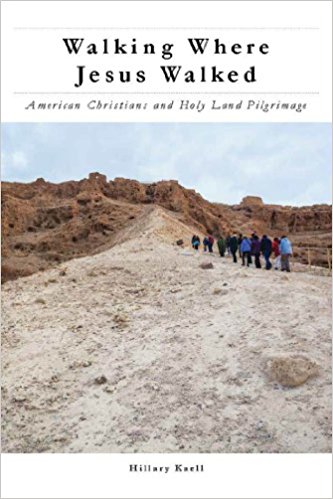
In this context, Hillary Kaell’s Walking Where Jesus Walked: American Christians and Holy Land Pilgrimage is a fascinating and sensitive look at Catholic and Evangelical Protestant travelers to the biblical origin of their faiths. While there are numerous studies on Holy Land pilgrimage in a variety of languages that focus on a diversity of time periods and demographics, Kaell’s is not only one of the first to center squarely on contemporary American travelers, but it also does so through the holistic approach of following pilgrims—whom she calls the “foot soldiers” of this profitable travel industry—before, during, and after the trip itself. Her work is based on ethnographic research—the qualitative bread-and-butter of anthropological inquiry—including participant observation (interacting with and observing her subjects while participating as a pilgrim), open-ended interviews, and some survey research. As a result, this well-organized and eminently readable monograph is punctuated by thick description and illuminating, often quite emotionally engaging interviews that bring its pilgrim voices to life.

The binary oppositions between ancient/modern, pilgrimage/tourism, religion/commercialism, public/private, interior/exterior, and Catholic/Protestant in Holy Land pilgrimage structure Kaell’s book. In particular, she argues that a common thread linking all of these dualities is the way that the actors negotiate a “problem of presence.” That is, how are Jesus and the biblical events of the past made present to these travelers? By voluntarily undertaking a “trip of a lifetime” (as many of her informants call it) to quite literally “walk where Jesus walked,” pilgrims are confronted with existential and ontological questions triggered by comparing their present experiences and future objectives with an idealized, imagined religious past. They therefore must work to resolve these issues. Traveling abroad and experiencing Otherness forces them to take stock of their lives at home; confronting other Christian denominations and religions (from Messianic Jews and Arab Christians to Jewish Israelis and Muslim Palestinians) obliges them to rethink taken-for-granted assumptions about religious pluralism. Moreover, encountering the directives of the tour’s spiritual leaders with their desire to take photographs and purchase souvenirs compels them to negotiate their notions of duty, kinship, age and gender. Indeed, these latter elements are central to Kaell’s analysis: a vast majority of these pilgrims are retired women (“middle-old,” they say), who frequently make sense of their actions by drawing on common gender stereotypes: that women are more spiritual than men, more inclined to shop, and bear a larger burden for transmitting religious faith to their family.

Leia o texto completo.

O livro

KAELL, H. Walking Where Jesus Walked: American Christians and Holy Land Pilgrimage. New York: New York University Press, 2014, 286 p. – ISBN 9781479831845.


KAELL, H. Walking Where Jesus Walked: American Christians and Holy Land Pilgrimage. New York: New York University Press, 2014, 286 p.

Quem é Michael A. Di Giovine?

Michael A. Di Giovine is Assistant Professor of Anthropology at West Chester University and Honorary Fellow at the University of Wisconsin-Madison. The author of The Heritage-scape: UNESCO, World Heritage and Tourism and co-editor of The Seductions of Pilgrimage: Sacred Journeys Afar and Astray in the Western Religious Tradition, his research focuses on the intersection of pilgrimage, tourism and cultural heritage, particularly as it relates to the global cult of St. Padre Pio of Pietrelcina and UNESCO’s World Heritage program. A former tour operator, Michael is Convenor of the Anthropology of Tourism Interest Group at the American Anthropological Association, and co-editor of Lexington Books’ series, The Anthropology of Tourism: Heritage, Mobility and Society. Home Page: http://www.michaeldigiovine.com/

Deste autor, leia:

DI GIOVINE, M. A.; PICARD, D. The Seductions of Pilgrimage: Sacred Journeys Afar and Astray in the Western Religious Tradition. Revised ed. Abingdon: Routledge, 2016, 288 p. -ISBN 9781472440075.

The Seductions of Pilgrimage explores the simultaneously attractive and repellent, beguiling and alluring forms of seduction in pilgrimage. It focuses on the varied discursive, imaginative, and practical mechanisms of seduction that draw individual pilgrims to a pilgrimage site; the objects, places, and paradigms that pilgrims leave behind as they embark on their hyper-meaningful travel experience; and the often unforeseen elements that lead pilgrims off their desired course. Presenting the first comprehensive study of the role of seduction on individual pilgrims in the study of pilgrimage and tourism, it will appeal to scholars of anthropology, cultural geography, tourism, heritage, and religious studies.

DI GIOVINE, M. A.; PICARD, D. Tourism and the Power of Otherness: Seductions of Difference. Bristol: Channel View Publications, 2014, 208 p. – ISBN 9781845414153.

This book explores the paradoxes of Self–Other relations in the field of tourism. It particularly focuses on the ‘power’ of different forms of ‘Otherness’ to seduce and to disrupt, and, eventually, also to renew the social and cosmological orders of ‘modern’ culture and everyday life. Drawing on a series of ethnographic case studies, the contributors investigate the production, socialization and symbolic encompassment of different ‘Others’ as a political and also an economic resource to govern social life in the present. The volume provides a comparative inductive study on the modernist philosophical concepts of time, ‘Otherness’, and the self in practice, and relates it to contemporary tourism and mobility.
Pensando a economia antiga

Theorizing “the Ancient Economy”: Three Paradigms

By Thomas R. Blanton IV – Ancient Jew Review – April 12, 2017

Abbreviated version of a paper delivered at the Early Christianity and the Ancient Economy session; SBL Annual Meeting 2016.

It would seem that the study of “the ancient economy” is in a period of ferment. Three new SBL program units have been added since 2004 that treat aspects of the ancient economy: Early Christianity and the Ancient Economy, Economics in the Biblical World, and Poverty in the Biblical World. In the field of classical studies, the 2008 publication of The Cambridge Economic History of the Greco-Roman World has effectively ushered in a post-Finleyan era in the study of Greco-Roman economies by incorporating methods developed in the field of New Institutional Economics. In what follows, we examine representative samples of three emergent methodological trends: (1) the turn toward New Institutional Economics in studies of Greece and Rome; (2) Roland Boer’s model of the economy of ancient Israel; and (3) K. C. Hanson and Douglas Oakman’s social-scientific approach in New Testament studies. These models differ significantly from each other and are drawn from what are often treated as three distinct fields: classics, Hebrew Bible, and New Testament studies. It is precisely the differences between the models that are most illuminating, however, and juxtaposing them quickly reveals the emphases—and omissions—that are specific to and that characterize each model.

Leia o texto completo.

Leia Mais:
Douglas Oakman no Observatório Bíblico
Roland Boer no Observatório Bíblico
K. C. Hanson no Observatório Bíblico