Jesus existiu mesmo?

Assista no YouTube :

:. Jesus existiu? Especial Semana Santa, parte 1 – 12.04.2017
Atendendo a pedidos do pessoal que assiste ao canal e tentando dissipar as eternas dúvidas sobre o tema, começo uma minissérie de Semana Santa sobre as dúvidas a respeito da existência histórica de Jesus. Afinal, há alguma base por trás da tese que afirma que Jesus Cristo foi apenas um mito inventado pelos primeiros cristãos?

:. Textos sobre Jesus foram forjados? Especial Semana Santa, parte 2 – 14.04.2017
Afinal, será que historiadores e cronistas não cristãos do século I d.C. chegaram a mencionar Jesus ou os textos que chegaram até nós são apenas fraude deslavada? Neste vídeo, vamos examinar em detalhes três exemplos dessas menções. O consenso entre os historiadores é que pelo menos duas delas são autênticas, o que indicaria que Jesus, embora não fosse nem de longe famoso ou importante naquele momento, era visto como um personagem real, e não como um mito. 

:. Paulo inventou o mito de Jesus? Especial Semana Santa, parte 3 – 15.04.2017
Será que os textos mais antigos do Novo Testamento, como as cartas do apóstolo Paulo e o Evangelho de Marcos, indicam que Jesus não foi um ser humano real, mas simplesmente um mito criado pelos primeiros cristãos como base para uma nova seita mística? Essa, em resumo, é a tese do livro “Nailed” (um trocadilho com as palavras em inglês para “pregado” e “resolvido”), escrito pelo historiador e ativista ateu americano David Fitzgerald. A obra de Fitzgerald é a primeira da corrente miticista (ou seja, dos historiadores que defendem que Jesus não foi uma pessoa real, mas apenas uma figura mítica) a chegar ao Brasil. Neste vídeo, explico os principais argumentos de Fitzgerald e conto por que, embora o autor tenha tentado fazer um trabalho sério, a tese dele não se sustenta nem de longe, na minha opinião — e na opinião da imensa maioria dos historiadores do cristianismo primitivo.

Por Reinaldo José Lopes.

Veja também outros vídeos de Reinaldo José Lopes.
Nono Seminário Henóquico

9th Enoch Seminar, June 18-23, 2017: “From tôrāh to Torah: Variegated Notions of Torah from the First Temple Period to Late Antiquity”

Chairs: William M. Schniedewind (University of California at Los Angeles) and Jason M. Zurawski (University of Groningen), in collaboration with Gabriele Boccaccini (Director of the Enoch Seminar).

Date: June 18-23, 2017

Place: Monastero di Camaldoli, Camaldoli, Italy

Area of Focus:

The Enoch Seminar and the resultant volume will examine the diverse understandings of tôrāh, beginning with the texts of the Hebrew Bible through to the Second Temple period and late antiquity, moving beyond traditional paradigms such as the early usage of tôrāh as general instruction vs. the transition to nomos, as “law,” or the development of a “normative” notion of Torah (capitalization intentional) in the Second Temple period. Participants are encouraged to rethink our scholarly assumptions and preconceptions on the topic and tackle the questions anew in light of more critical philological and historical approaches. We seek to examine the various notions of tôrāh (and nomos) in all relevant literature, regardless of scholarly or denominational corpora, both within ancient Jewish/Judean traditions and in light of broader influences, whether Egyptian, Mesopotamian, Greek, Roman, Persian, etc. As this meeting follows and builds upon the work from the Fifth Nangeroni Meeting, “Second Temple Jewish Paideia in its Ancient Near Eastern and Hellenistic Contexts” (June/July 2015), discussions pertaining to the connections between tôrāh/Torah/nomos/dat and education, pedagogy, wisdom, etc., are especially encouraging. Our aim will be to discuss the variety of ways that tôrāh was defined and developed in the literature.

Visite: 4 Enoch: The Online Encyclopedia of Second Temple Judaism, and Christian and Islamic Origins

Uma história do Novo Testamento em latim

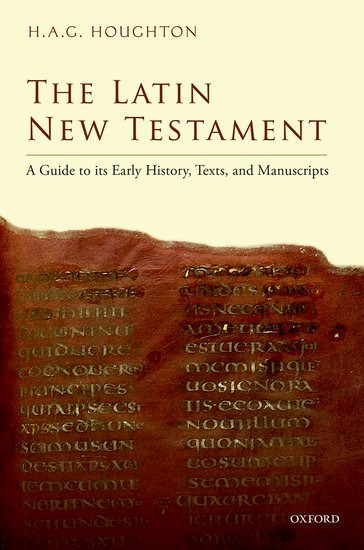
HOUGHTON, H. A. G. The Latin New Testament: A Guide to its Early History, Texts, and Manuscripts. Oxford: Oxford University Press, 2016, 400 p. – ISBN 9780198744733.

HOUGHTON, H. A. G. The Latin New Testament: A Guide to its Early History, Texts, and Manuscripts. Oxford: Oxford University Press, 2016, 400 p.

O livro

This book provides a comprehensive introduction to the history and development of the Latin New Testament and a user’s guide to the resources available for research and further study. The first five chapters offer a new historical synthesis, bringing together evidence from Christian authors and biblical manuscripts from earliest times to the late Middle Ages. Each witness is considered in its chronological and geographical context, to build up the bigger picture of the transmission of the text. There are chapters introducing features of Latin biblical manuscripts and examining how the Latin tradition may serve as a witness for the Greek New Testament. In addition, each book of the New Testament is considered in turn, with details of the principal witnesses and features of particular textual interest. The three main scholarly editions of the Latin New Testament (the Vetus Latina edition, the Stuttgart Vulgate, and the Oxford Vulgate) are described in detail. Information is also given about other editions and resources, enabling researchers to understand the significance of different approaches and become aware of the latest developments. The Catalogue of Manuscripts gives full details of each manuscript used in the major editions, with bibliographical references and links to sets of digital images. The Appendices include concordances for the different ways in which manuscripts are cited in scholarly literature. An extensive reference bibliography of publications on the Latin New Testament is also supplied.

O sumário

Part I: History
1. From the Beginnings to the End of the Third Century
2. The Fourth Century and the Beginning of the Vulgate
3. Competing Texts: The Fifth to the Seventh Centuries
4. The Eighth and Ninth Centuries
5. The Tenth Century Onwards: Scholarship and Heresy
Part II: Texts
6. Editions and Resources
7. An Overview of the Text of the Latin New Testament
Part III
8. Features of Latin Biblical Manuscripts
9. Catalogue of Latin New Testament Manuscripts
Appendices
1. Concordances of Manuscript Sigla
2. Latin Prefaces, Prologues, and Capitula for the Books of the New Testament
Bibliography

O autor

H.A.G. Houghton is Reader in New Testament Textual Scholarship at the University of Birmingham, where he is also Deputy Director of the Institute for Textual Scholarship and Electronic Editing. He is one of the editors of the Gospel according to John and corresponding editor for the principal Pauline Epistles in the Vetus Latina series.

Download gratuito em pdf. Clique aqui.

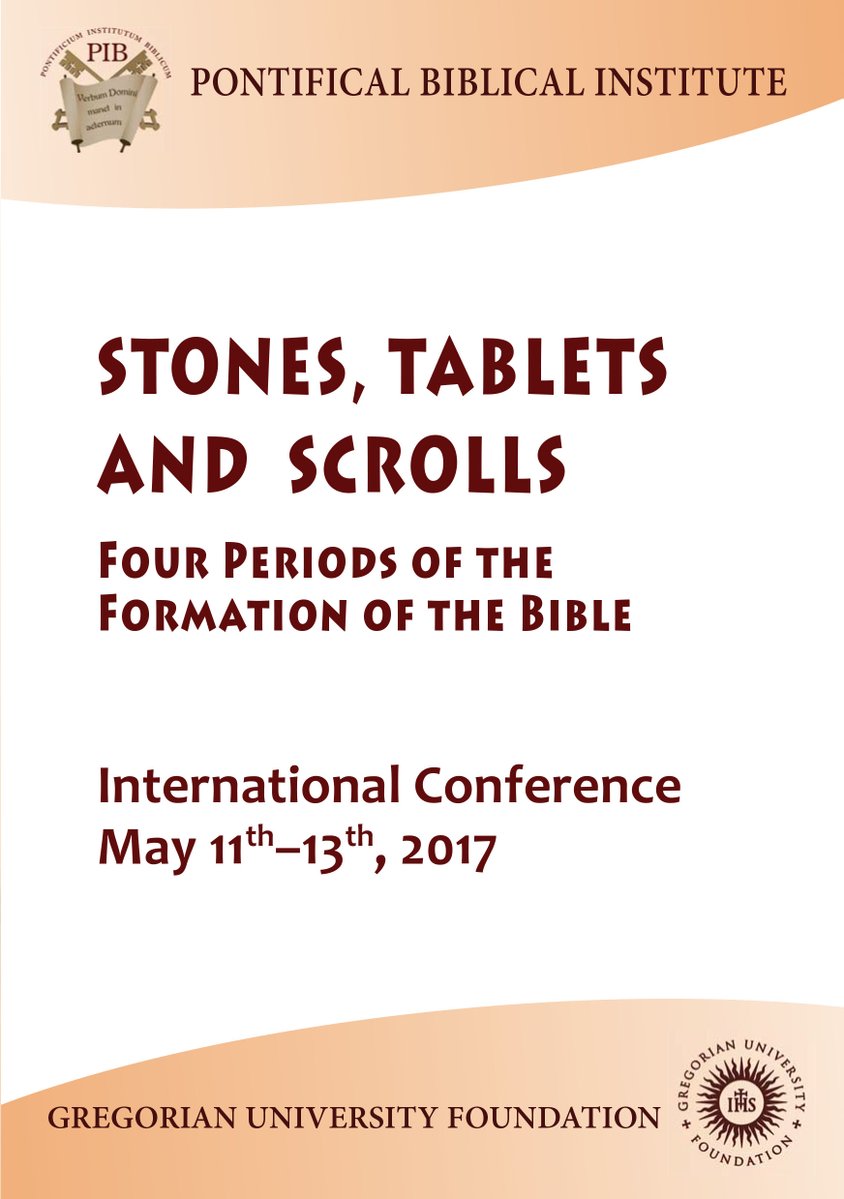
Pedras, tabuinhas e rolos: quatro períodos da formação da Bíblia

Conferência Internacional no PIB – Pontifício Instituto Bíblico: 11-13 de maio de 2017

Stones, Tablets and Scrolls: Four Periods of the Formation of the Bible

Conferência Internacional no PIB: Stones, Tablets and Scrolls: Four Periods of the Formation of the Bible

Com 24 conferencistas:

Alice M. W. Hunt (University of Georgia, Athens, GA), Eckart Frahm (Yale University, New Haven, CT), Peter Dubovský (Pontifical Biblical Institute, Rome), Peter Machinist (Harvard University, Cambridge, MA), Jean Louis Ska (Pontifical Biblical Institute, Rome), Jeffrey Zorn (Cornell University, Ithaca, NY), Michael Jursa (Universität Wien), Hermann-Josef Stipp (Ludwig Maximilians-Universität, Munich), David Vanderhooft (Boston College, Chestnut Hill, MA), Erhard Blum (Universität Tübingen), Pierfrancesco Callieri (Università di Bologna, campus di Ravenna), Agustinus Gianto (Pontifical Biblical Institute, Rome), Eric Meyers (Duke University, Durham, NC), Diana Edelman (University of Oslo), Federico Giuntoli (Pontifical Biblical Institute, Rome), Israel Finkelstein (Tel Aviv University), Thomas Römer (Collège de France, Paris), Oren Tal (Tel Aviv University),  Joseph Sievers (Pontifical Biblical Institute, Rome), Barbara Schmitz (Universität Würzburg), Katell Berthelot (Centre National de la Recherche Scientifique, Aix-en-Provence), Henryk Drawnel (Katolicki Uniwersytet Lubelski, Lublin), Marcello Fidanzio (Facoltà di Teologia di Lugano) e Emanuel Tov (Hebrew University, Jerusalem)

Veja o programa em pdf clicando aqui.

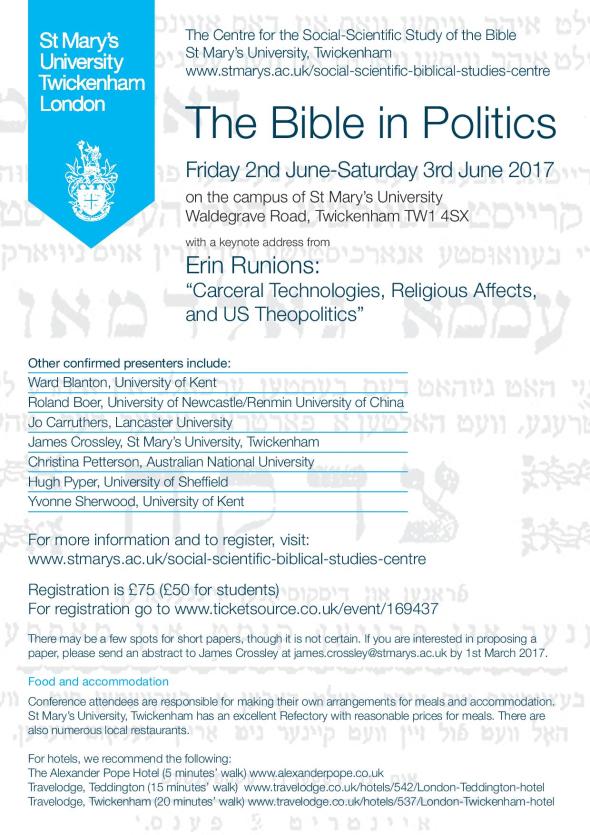
Análise crítica do uso da Bíblia na política

Tema de uma conferência: The Bible in Politics

2-3 June, 2017 – St Mary’s University, Waldegrave Drawing Room, Twickenham, London

The Bible in Politics

A Bíblia, pelo menos em algum momento, funcionou como uma autoridade transcendente para a maioria, senão todas, as ideologias políticas contemporâneas.

A conferência “A Bíblia na Política” apresentará algumas das pesquisas mais recentes, em diálogo com impulsos teóricos mais amplos nas Humanidades.

Abrangerá os usos da Bíblia em diversas tradições e questões políticas em diferentes contextos geográficos, com ênfase particular nos usos contemporâneos e/ou naqueles relacionados ao desenvolvimento da modernidade capitalista.


The Bible has, at some time at least, functioned as a transcendent authority for most, if not all, contemporary political ideologies. The ‘Bible in Politics’ conference will showcase some of the latest scholarship, in conversation with larger theoretical impulses in the Humanities. It will cover uses of the Bible in a variety of political traditions and issues in different geographical contexts, with a particular emphasis on contemporary uses and/or those and in the development of capitalist modernity.

Tema atual, pessoas interessantes.

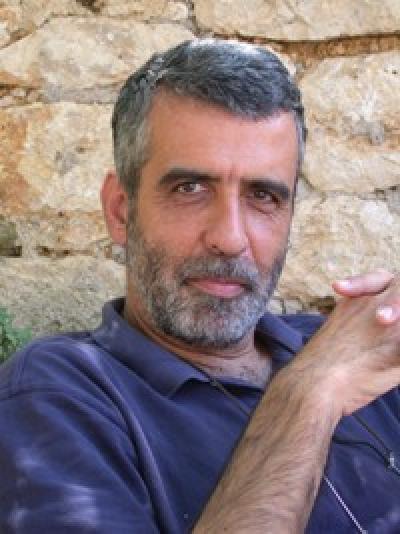
Aniversário de Finkelstein

Hoje o arqueólogo Israel Finkelstein está comemorando 68 anos de vida.

Parabéns, Professor Finkelstein!

Israel Finkelstein (born March 29, 1949)

Sobre o mais importante arqueólogo da Palestina na atualidade, suas pesquisas e publicações, confira aqui e aqui.

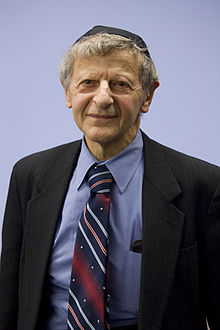
Morreu Louis H. Feldman

Morreu anteontem, aos 90 anos, o renomado pesquisador da obra de Flávio Josefo, Louis H. Feldman (29 de outubro de 1926 – 25 de março de 2017).

Veja a bibliografia de Louis H. Feldman no WorldCat e na Amazon.

Louis H. Feldman: 29.10.1926-25.03.2017

Na Encyclopaedia Judaica, leio:

FELDMAN, LOUIS H. (1926– ), U.S. professor of classics and literature. Born in Hartford, Connecticut, Feldman received his undergraduate degree from Trinity College in 1946, and his master’s degree in 1947; his doctoral degree in classical philology is from Harvard University (1951).

He was a teaching fellow at Trinity in 1951 and 1952, then an instructor in classics in 1952 and 1953. He was an instructor at Hobart and William Smith Colleges from 1953 to 1955, then joined Yeshiva University of New York as an instructor in humanities and history. He was an assistant professor at Yeshiva University from 1956 to 1961, an associate professor from 1961, and he was appointed a professor of classics in 1966. He subsequently became the Abraham Wouk Family Professor of Classics and Literature.

Feldman served as associate editor of Classical Weekly from 1955 to 1957 and as managing editor of Classical World from 1957 to 1959.

Feldman is renowned as a scholar of Hellenistic civilization, specifically of the works of Josephus.

Fonte: Dorothy Bauhoff – Encyclopaedia Judaica, 2nd ed., 2007.

A lista de discussão H-Judaic diz dele:

H-Judaic is deeply saddened to learn [from Dr Edward Reichman and Menachem Butler] of the passing of Professor Louis Feldman (1926-2017), the Abraham Wouk Family Professor of Classics and Literature at Yeshiva University, where Prof. Feldman taught for some 60 years.  Prof. Feldman was recognized around the world as the “Dean” of Josephus scholars and contributed greatly to our understanding of Jewish life during the Hellenistic era. He published numerous books and hundreds of articles — 243 are listed in RAMBI. He was a “scholar’s scholar” — a model of dedication to craft coupled with modesty and wide-ranging learning.

A apocalíptica judaica e o Novo Testamento

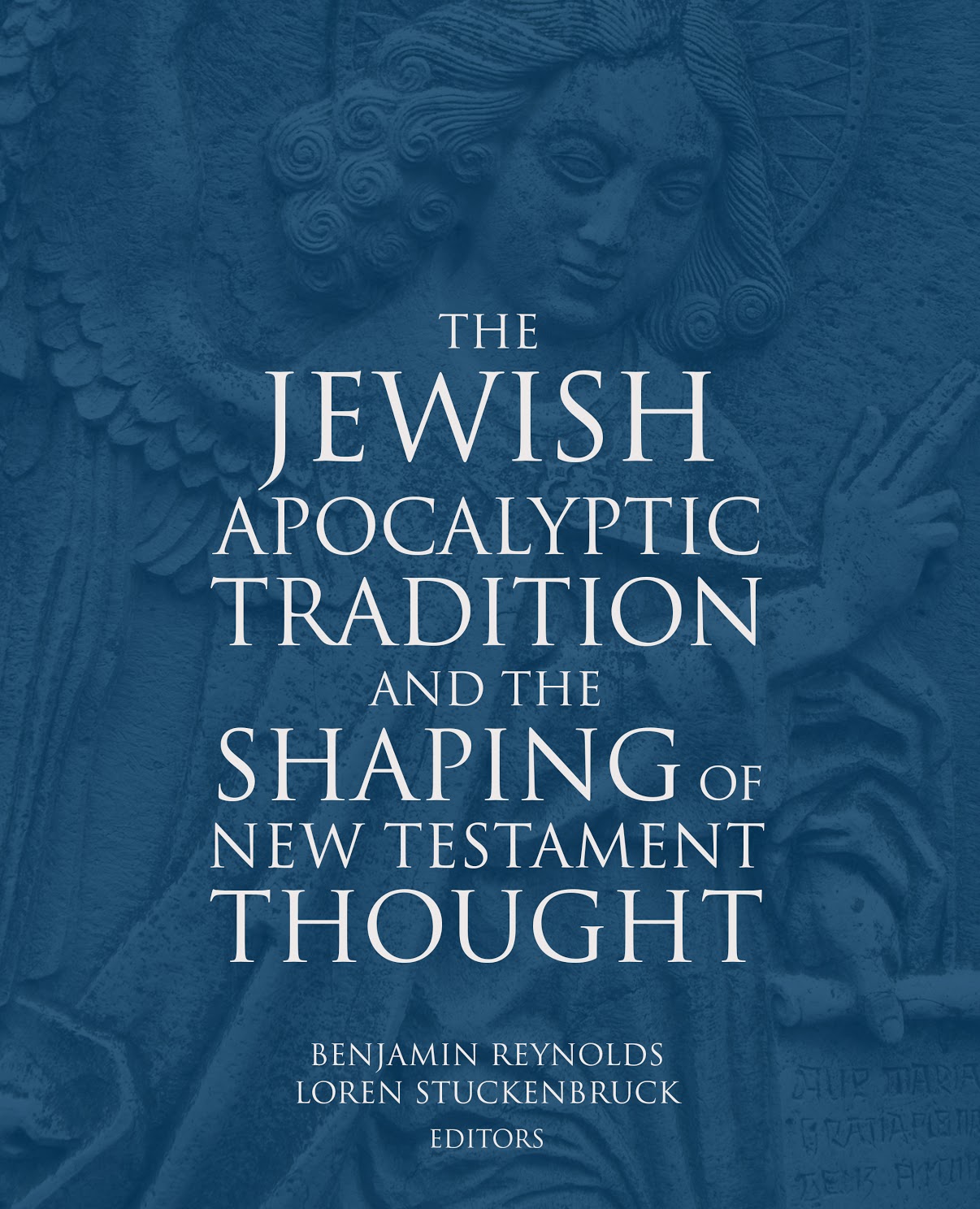
REYNOLDS, B. E. ; STUCKENBRUCK, L. T.  (eds.) The Jewish Apocalyptic Tradition and the Shaping of New Testament Thought. Minneapolis: Fortress Press, 2017, 300 p. – ISBN 9781451492668.

REYNOLDS, B. E. ; STUCKENBRUCK, L. T.  (eds.) The Jewish Apocalyptic Tradition and the Shaping of New Testament Thought. Minneapolis: Fortress Press, 2017, 300 p.

The contemporary study of Jewish apocalypticism today recognizes the wealth and diversity of ancient traditions concerned with the ‘unveiling’ of heavenly matters – understood to involve revealed wisdom, the revealed resolution of time, and revealed cosmology – in marked contrast to an earlier focus on eschatology as such. The shift in focus has had a more direct impact on the study of ancient ‘pseudepigraphic’ literature, however, than in New Testament studies, where the narrower focus on eschatological expectation remains dominant. In this Companion, an international team of scholars draws out the implications of the newest scholarship for the variety of New Testament writings. Each entry presses the boundaries of current discussion regarding the nature of apocalypticism in application to a particular New Testament author. The cumulative effect is to reveal, as never before, early Christianity, its Christology, cosmology, and eschatology, as expressions of tendencies in Second Temple Judaism.

Benjamin E. Reynolds is associate professor of New Testament at Tyndale University College in Toronto, Canada. He is author of The Apocalyptic Son of Man in the Gospel of John.

Loren T. Stuckenbruck is chair of New Testament and Second Temple Judaism at Evangelisch-Theologische Fakultat, Ludwig-Maximilians-Universitat, Munich. His numerous works include Angel Veneration and Christology: A Study in Early Judaism and in the Christology of the Apocalypse of John and a commentary on 1 Enoch 91–108 in the Commentaries in Early Jewish Literature series.