Desenterrando o berço do alfabeto: arqueólogos retornam após 14 anos de silêncio
Após mais de uma década de silêncio, a antiga civilização de Ugarit, outrora um dos centros comerciais mais influentes da Idade do Bronze Recente, está voltando à tona. Arqueólogos retomaram as escavações perto de Latakia, no noroeste da Síria, revelando camadas há muito enterradas de uma cidade que moldou a história cultural e linguística do mundo antigo.
Localizada a cerca de 12 quilômetros ao norte de Latakia, na atual Ras Shamra, Ugarit foi uma vibrante cidade costeira que prosperou entre 1450 e 1195 a.C. Conhecida por suas extensas redes comerciais que ligavam o Egito, a Anatólia, Chipre e a Mesopotâmia, a cidade se erguia como uma encruzilhada de comércio e cultura no antigo Oriente Médio. Os estudiosos acreditam que a destruição repentina de Ugarit por volta de 1190 a.C. foi resultado das invasões dos misteriosos povos do mar, uma coalizão que remodelou o mapa do Mediterrâneo oriental.
Retorno das escavações após 14 anos
As missões arqueológicas na Síria foram praticamente interrompidas após o início da guerra civil em 2011. Agora, após um hiato de 14 anos, uma nova equipe arqueológica conjunta ítalo-síria retomou os trabalhos de campo perto da cidade costeira. A missão é liderada pelo Prof. Lorenzo d’Alfonso, da Universidade de Pavia, Itália, um dos maiores especialistas em arqueologia e história da arte do antigo Oriente Médio.
Em declarações à imprensa local, d’Alfonso confirmou que a equipe, que inclui doutorandos da Turquia e da Itália, está realizando uma escavação de um mês em Tell Semhane, um monte até então inexplorado que se acredita ter ligações com o reino ugarítico. “Estamos escavando estratos da Idade do Bronze em Tell Semhane”, disse d’Alfonso. “Nenhum trabalho arqueológico anterior foi feito aqui, o que torna esta missão particularmente significativa.”
O trabalho está sendo realizado em estreita cooperação com o Museu de Latakia e a Direção Síria de Antiguidades, com planos futuros de incluir estudantes da Universidade de Damasco.
Uma nova janela para a civilização ugarítica
Segundo Muhammad al-Hasan, chefe do Departamento de Antiguidades de Latakia, as descobertas desta temporada podem fornecer informações valiosas sobre a estrutura política e social do reino de Ugarit. O sítio arqueológico, localizado a apenas cinco quilômetros do centro de Latakia, pode ter funcionado como um assentamento satélite ligado à extensa rede econômica e administrativa de Ugarit.
Hasan enfatizou a intenção da Síria de facilitar o retorno de missões arqueológicas internacionais. “Estamos oferecendo todo o apoio possível às equipes estrangeiras que trabalham na região costeira”, disse ele. “Essas colaborações não apenas revitalizam a pesquisa científica, mas também fortalecem os laços culturais.”
(…)
Uma civilização redescoberta
A redescoberta de Ugarit não é apenas um triunfo arqueológico, mas também um ato simbólico de resiliência cultural. Outrora reduzida a cinzas por invasores estrangeiros e, mais recentemente, silenciada pela guerra, o renascimento da cidade por meio de escavações marca uma renovada valorização do patrimônio ancestral da Síria.
Enquanto pás e pincéis voltam a peneirar o solo de Ras Shamra, cada fragmento desenterrado conta uma história — de mercadores, escribas e reis que construíram um dos primeiros centros de alfabetização e comércio internacional. As novas descobertas prometem lançar luz sobre como Ugarit conectou civilizações por todo o Mediterrâneo e o Oriente Médio, lembrando ao mundo que, mesmo após milênios de silêncio, a história ainda fala.
No Observatório Bíblico, você pode ler sobre Ugarit aqui e aqui. Na Ayrton’s Biblical Page, você pode ler sobre os povos do mar aqui.
Unearthing the Birthplace of the Alphabet: Archaeologists Return After 14 Years of Silence
After more than a decade of silence, the ancient civilization of Ugarit, once one of the most influential trade hubs of the Late Bronze Age, is coming back into focus. Archaeologists have resumed excavations near Latakia, northwestern Syria, revealing long-buried layers of a city that shaped the cultural and linguistic history of the ancient world.
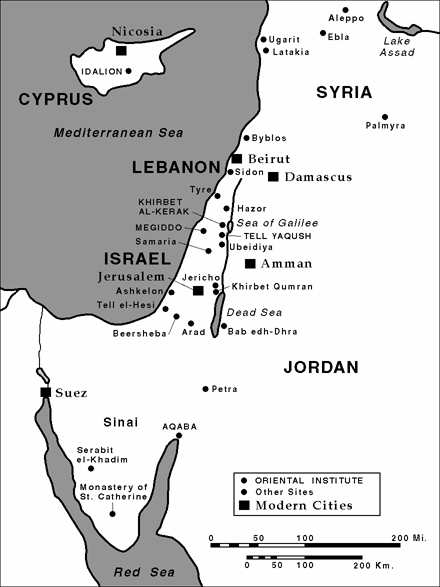 Located about 12 kilometers north of Latakia, in what is now Ras Shamra, Ugarit was a vibrant coastal city that thrived between 1450 and 1195 BCE. Known for its extensive trade networks that linked Egypt, Anatolia, Cyprus, and Mesopotamia, the city stood as a crossroads of commerce and culture in the ancient Near East. Scholars believe that Ugarit’s sudden destruction around 1190 BCE was the result of invasions by the mysterious Sea Peoples, a coalition that reshaped the map of the eastern Mediterranean.
Return of Excavations After 14 Years
Archaeological missions in Syria were largely halted following the outbreak of the civil war in 2011. Now, after a 14-year hiatus, a new joint Italian-Syrian archaeological team has resumed fieldwork near the coastal city. The mission is led by Assoc. Prof. Lorenzo d’Alfonso of the University of Pavia, Italy, a leading expert in Ancient Near Eastern archaeology and art history.
Speaking to local reporters, d’Alfonso confirmed that the team, which includes doctoral students from Türkiy and Italy, is conducting a month-long excavation at Tell Semhane, a previously unexplored mound believed to have connections with the broader Ugaritic Kingdom. “We are excavating Bronze Age layers in Tell Semhane,” said d’Alfonso. “No previous archaeological work has been done here, which makes this mission particularly significant.”
The work is being carried out in close cooperation with the Latakia Museum and the Syrian Directorate of Antiquities, with future plans to include students from Damascus University.
A New Window into Ugaritic Civilization
According to Muhammad al-Hasan, head of the Latakia Department of Antiquities, this season’s findings could provide valuable insights into the political and social structure of the Ugaritic Kingdom. The site, located just five kilometers from Latakia’s city center, may have functioned as a satellite settlement linked to Ugarit’s wider economic and administrative network.
Hasan emphasized Syria’s intention to facilitate the return of international archaeological missions. “We are providing all possible support to foreign teams working in the coastal region,” he said. “These collaborations not only revive scientific research but also strengthen cultural ties.”
The Legacy of Ugarit: Birthplace of the Alphabet
Beyond its trade importance, Ugarit holds an extraordinary place in human history: it is the birthplace of the world’s first alphabetic writing system. Discovered in 1928 among thousands of clay tablets, the Ugaritic script — written in cuneiform but using an alphabet of 30 letters — revolutionized communication and became a model for later Semitic alphabets, including Phoenician and eventually Greek and Latin.
The Ugaritic archives, found in temples and palaces, include texts written in seven languages and four scripts, such as Akkadian, Hittite, and Hurrian. These texts offer a rare glimpse into Bronze Age diplomacy, trade, religion, and daily life — documenting treaties, hymns, myths, and administrative records.
Among the most famous discoveries from Ugarit are the Baal Cycle tablets, mythological poems that describe the storm god Baal’s struggle against chaos, providing early parallels to biblical narratives.
Students Bridging Cultures Through Archaeology
Turkish Ph.D. student Adahan Güney, one of the young archaeologists on-site, expressed his excitement about participating in the excavation. “Our goal is to uncover a Bronze Age settlement in its entirety,” he said. “In Near Eastern archaeology, most projects focus on temples or palaces. Here, we have the rare opportunity to study a complete settlement context, which could transform our understanding of everyday life in the Bronze Age.”
Working in four separate excavation areas, the team has already begun identifying surface artifacts and architectural remains. “We hope that by the end of the month, we will have a clearer picture of how this community functioned within the Ugaritic sphere,” Güney added.
A Civilization Rediscovered
The rediscovery of Ugarit is not just an archaeological triumph but also a symbolic act of cultural resilience. Once reduced to ashes by foreign invaders, and more recently silenced by war, the city’s rebirth through excavation marks a renewed appreciation for Syria’s ancient heritage.
As trowels and brushes once again sift through the soil of Ras Shamra, each unearthed fragment tells a story — of merchants, scribes, and kings who built one of the earliest hubs of literacy and international trade. The new findings promise to shed light on how Ugarit connected civilizations across the Mediterranean and the Near East, reminding the world that even after millennia of silence, history still speaks.
Fonte: Arkeonews – 10 November 2025